
Louis A. Perez, Jr.
Cuba in the American Imagination
A prospective reader drawn by happenstance would do well to open the book to p. 175 and proceed to look through the chapter “On Gratitude as Moral Currency of Empire.” The pages that follow examine the ways that representations of the war of 1898 developed into a central element of the moral logic by which the United States validated the exercise of power over Cuba in the twentieth century.
Americans understood themselves to have mobilized for war against Spain in 1898 in behalf of Cuban independence, to have succeeded where the Cubans had failed. The United States early appropriated full credit for the victory, with none shared with the Cubans. The moral, sometimes stated explicitly, other times left to inference, but always central to the U.S. narrative on 1898, was unambiguous: Spain had been defeated and expelled, through the resolve and resources of the United States, as a result of the effort and exertion of Americans, through their sacrifices, at the expense of their lives and the expenditure of their treasure. Cubans were henceforth proclaimed beneficiaries of the generosity of the United States, to whom they owed their deliverance and for which they were expected to be properly grateful.
The salience of gratitude as a discursive motif of the American representation of 1898 gave definitive form to the normative context of U.S. hegemony. Cubans were thus transformed from active to passive, from subjects to objects, from agents of their own liberation to recipients of North American largess. Thereafter they were expected always to be grateful to the Americans for the independence of Cuba. The American representation of 1898 served to sustain the U.S. claim of authority over the republic for the next sixty years. This must be considered as the dominant discursive modality by which the United States parlayed its version of 1898 into the rationale of domination.
An essential facet of the chapter deals with the emergence of a Cuban counter-narrative of 1898 and its role as a source of political mobilization contributing to the consolidation of the Cuban revolution after 1959. What was known in the United States as the “Spanish-American War” was understood in Cuba as the culmination of a three-year war of national liberation. Cubans defended their claim to independence as an achievement rightfully obtained through their own efforts.
They recalled more than three years of relentless war, which effectively drove the Spanish army into beleaguered defensive concentrations in the cities, there to suffer further the debilitating effects of illness and hunger, circumstances that in no small fashion contributed to the ease with which Spain was defeated in 1898. Cubans had already brought the Spanish army to the brink of defeat, and more than adequately contributed to the vastly weakened condition in which Spain labored to mobilize for war with the United States.
The question of 1898 insinuated itself deeply into Cuban national sensibilities, which meant, too, that it loomed large in public forums and political debates. In the nationalist discourses that emerged in subsequent decades, the year 1898 was remembered as a usurpation, a point of preemption, whereupon Cubans were displaced as actors and transformed into audience. The proposition of 1898 as a wrong to redress emerged early as one of the central themes of a Cuban nationalist counter-narrative, and served as a source of political mobilization in the weeks and months following the triumph of the Cuban revolution in 1959.
Cuba in the American Imagination seeks to offer an alternative mode for the analysis of the moral context from which Americans have presumed to exercise power in the world at large. In this order of things, the validation of hegemony was transacted most commonly within a system of symbolic representations, inscribed with conventional wisdom and received truths to convey as commonplace the premise and propriety of the exercise of U.S. power.
The use of metaphor has been vital in this process. Metaphors serve as a means to mediate reality and have so insinuated themselves into the commonplace political vernacular as to cease to be apprehended at all. Metaphors offer a cognitive context in which to apprehend the world, a way to arrive at an understanding of a time and place, often the very basis upon which a people choose one course of action among others.
To confront metaphor is not only to engage a form of knowledge but also to contend with a source of moral validation through which systems of domination normalize the rationale of power. To call attention to the activity of metaphor in this setting is to argue that systems of domination function best as a matter of moral inducement: where reality is embedded in borrowed cultural models. Metaphors contained within their very logic the capacity to expand fully into paradigms, whereupon they act to transform moral-to-live-by into prescription-to-act-upon.
This is to understand the use of metaphor as a deed of intent and purpose. To choose to mediate reality by way of one set of cultural representations is also and at the same time to prompt a culturally-determined and politically-desired course of conduct. Metaphors have their politics, and their politics are conveyed by way either of disguising differences or suggesting similarities. Point of view is inscribed within the metaphor, which is to suggest that the politics is embedded within the image. That is their purpose.
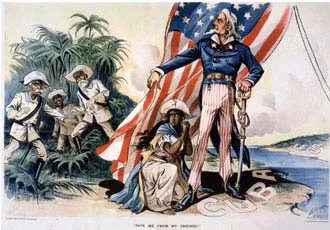
“Save me from My Friends!” Editorial cartoon from Puck, September 7, 1898. The caption reads: “Taking Cuba from Spain was easy. Preserving it from overzealous Cuban patriots is another matter.”
Editor: Erind Pajo
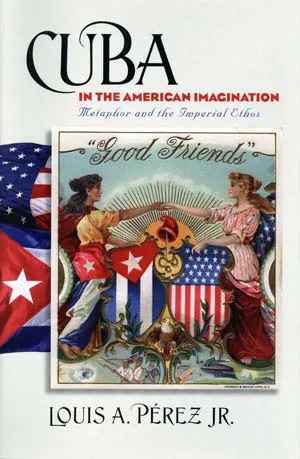
Cuba in the American Imagination
Louis A. Pérez, Jr. Cuba in the American Imagination: Metaphor and the Imperial Ethos University of North Carolina Press352 pages, 6 1/8 x 9 1/4 inches ISBN 978 0807832165
Available here →March 3, 2009
20090303-perez-louis-cuba-american-imagination-3
A close-up
The rest of this thread
Deborah M. Weissman
Louis A. Perez, Jr.
Louis A. Pérez, Jr. is the J. Carlyle Sitterson Professor of History and the Director of the Institute for the Study of the Americas at the University of North Carolina at Chapel Hill. Among his books are Cuba: Between Reform and Revolution (3rd edition, Oxford University Press, 2006), On Becoming Cuban: Identity, Nationality, and Culture (University of North Carolina Press, 1999), and To Die in Cuba: Suicide and Society (University of North Carolina Press, 2005).
Pull this thread
Americans knew Cuba almost entirely through metaphors of their own making, and those metaphors were the mechanism of policy.
Know something the rest of us don't?
Most threads on Rorotoko begin with our invitation. Any thread can begin with a proposal: you write it with the same prompts every thread answers, and we review it.
Propose a thread →