
Wendy Hui Kyong Chun
Control and Freedom
During the Afghanistan War, the second Gulf War and the subsequent occupation, t-shirts, bumper stickers, and politicians reminded us, “Freedom is not Free.” This phrase, engraved on the Korean War Memorial in Washington, DC, would seem simply to say that freedom comes at the cost of soldiers’ lives and civilian sacrifices. Freedom is not without cost; someone has to pay a price. This phrase, however, is open to another reading: when freedom is conflated with security, freedom loses its meaning—freedom is no longer free. If freedom is reduced to a gated community writ large, or becomes the ideological watchword of a national security state, then it can turn into nothing more than the partner of, or the alibi for, control. The very phrase “freedom is not free” can make freedom unfree when it calls on people to accept unfreedom as the cost of freedom.
“Free” can also mean priceless, a gift. In English, the word “free” stems from the Sanskrit word for “dear” or “beloved.” The phrase “freedom is not free” should never make sense, for what is free should never be devalued. The value of freedom underlined by the etymology is erased when we shift the emphasis away from the action of giving something freely—not in return for something else—to the economism or opportunism of a recipient, who, looking for a bargain, refuses to acknowledge this liberality and thus literally cheapens the act. This cheapening of freedom is crucial to the conflation of control with freedom.
Control and Freedom: Power and Paranoia in the Age of Fiber Optics examines “freedom” through the rubric of the Internet, more specifically, through its emergence as a mass medium. Emphasizing the roles of sexuality and race, this book traces the ways in which a technology, which thrives on control, has been accepted, however briefly, as a mass medium of freedom. Indeed, this book was initially driven by the question: why do sex and sexuality dominate descriptions of networked connectivity?
From hardware to software, sex encapsulates the thrills and the dangers of networked contact. In terms of hardware, male-to-female connectors configure all electronic information exchange as electrifying heterosexual intercourse. In terms of software, computer viruses spread like sexually transmitted diseases, contaminating and reproducing uncontrollably; our computers are attacked through their back orifices. In terms of content, pornography is “all over the Internet,” saturating the digital landscape and ranking among its more popular recreational uses. In terms of technology development, sex allegedly drives progress and popularizes new devices: pornography is the “killer application” that convinces consumers to invest in new hardware.
These metaphors of sexuality not only coincide with a certain logic of sexual liberation (and danger), they also enable new regulations—a finer gird of control, one that remaps the private/public divide as open/closed. Sexuality is the linchpin for strategies as diverse as entrepreneurial capitalism, censorship and surveillance. Cyberporn—and attempts to regulate it, in particular legislation that endorsed credit card verification—fueled the dot-com craze. In terms of censorship and surveillance, sexuality encapsulated and sequestered, and still encapsulates and sequesters, the risk of being online; anxiety over or desire for online contact is expressed as anxiety over/desire for sexual exposure. In the face of catastrophic, unrestrained, and unrestrainable contact that could compromise our children’s sexual well-being, we were, and are, called to place ourselves under surveillance. Fiber optic networks threaten a freedom and a democratization that threaten to verge out of control, as well as calls for security bent on destroying them.
Editor: Erind Pajo
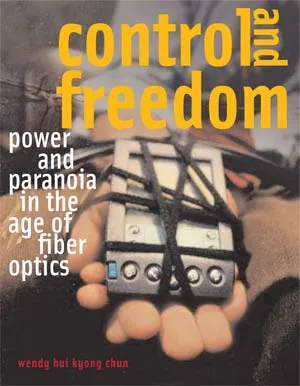
Control and Freedom
Wendy Chun Control and Freedom: Power and Paranoia in the Age of Fiber Optics MIT Press 368 pages, 7 x 9 inches ISBN 978 0262533065 ISBN 978 0262033329
Available here →March 17, 2009
20090317-chun-wendy-control-freedom-power-paranoia-age-fiber-optics-2
The wide angle
The rest of this thread
Wendy Hui Kyong Chun
Wendy Chun is an associate professor of Modern Culture and Media at Brown University. She has studied both Systems Design Engineering and English Literature, which she combines and mutates in her current work on digital media. She is author of Control and Freedom: Power and Paranoia in the Age of Fiber Optics (MIT, 2006), and co-editor (with Thomas Keenan) of New Media, Old Media: A History and Theory Reader (Routledge, 2006). Her articles have appeared in Critical Inquiry, differences, and grey room, amongst other places. She is currently working on a monograph entitled Programmed Visions: Software, DNA, Race (forthcoming MIT, 2010).
Pull this thread
The Internet, a control technology, passed as a medium of freedom because freedom and control had been coupled.
Know something the rest of us don't?
Most threads on Rorotoko begin with our invitation. Any thread can begin with a proposal: you write it with the same prompts every thread answers, and we review it.
Propose a thread →