
Wendy Hui Kyong Chun
Control and Freedom
The Internet is a technology based on control systems, yet it is also a mass medium celebrated as fostering personal and political freedom. How? Why? What dreams and desires drove the Internet’s transformation from a communications network used mainly by academics and the military to an integral part of everyday life? And how does the experience of actually using the Internet differ from the hype that surrounds it? Driven by these questions, Control and Freedom: Power and Paranoia in the Age of Fiber Optics argues that a strange coupling of control and freedom has been central to Internet’s emergence as a commercial mass medium. This coupling is also prevalent in the broader U.S. political landscape: we are only free, we are told, if we are in control, if the gates that surround us hold. To secure this freedom, political problems are re-written as technological ones and pre-emption over-rides prevention, spreading paranoia everywhere. Because our technologies always fail, we must be paranoid to be somewhat secure. This constant failure of technology, however, also points to an alternate path, one that understands that control can never secure freedom and that freedom, rather than resulting from control, makes control possible, necessary, and never enough.
So, importantly, Control and Freedom denigrates neither the Internet nor freedom. Rather, it argues that the Internet’s potential for democracy stems not from illusory promises of individual empowerment, but rather from the ways in which it exposes us to others, and to other machines. That is, from the way it exposes to a freedom we cannot control. To exploit this potential, we need to engage all layers of the Internet—hardware, software, interface, and extra-medial representation—to see where the gaps lie and to understand the differences between technological and social control.
Editor: Erind Pajo
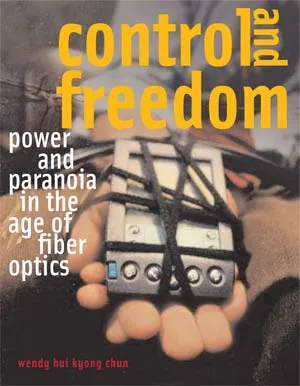
Control and Freedom
Wendy Chun Control and Freedom: Power and Paranoia in the Age of Fiber Optics MIT Press 368 pages, 7 x 9 inches ISBN 978 0262533065 ISBN 978 0262033329
Available here →March 17, 2009
20090317-chun-wendy-control-freedom-power-paranoia-age-fiber-optics-1-1
In a nutshell
The rest of this thread
Wendy Hui Kyong Chun
Wendy Chun is an associate professor of Modern Culture and Media at Brown University. She has studied both Systems Design Engineering and English Literature, which she combines and mutates in her current work on digital media. She is author of Control and Freedom: Power and Paranoia in the Age of Fiber Optics (MIT, 2006), and co-editor (with Thomas Keenan) of New Media, Old Media: A History and Theory Reader (Routledge, 2006). Her articles have appeared in Critical Inquiry, differences, and grey room, amongst other places. She is currently working on a monograph entitled Programmed Visions: Software, DNA, Race (forthcoming MIT, 2010).
Pull this thread
The Internet was sold as a medium of freedom though it is a technology of control.
Know something the rest of us don't?
Most threads on Rorotoko begin with our invitation. Any thread can begin with a proposal: you write it with the same prompts every thread answers, and we review it.
Propose a thread →