
Bernard Mergen
Weather Matters
Weather Matters is a history of all these phenomena. It explores the questions why and how we talk about the weather in science, the media, popular culture, and the arts. It seeks to explain how we perceive, manage, and market the weather. It has been estimated that up to 70% of all businesses are vulnerable to weather hazards. Trillions of dollars are lost annually because of storms and erroneous forecasts. Yet, Americans pay less than the price of a movie ticket annually to support the National Weather Service.
Readers of Weather Matters will learn how weather bureaucracies evolved over the past century, why the management of weather risks is difficult, and how weather remains a way of understanding nature and our place in it.
As I discovered when writing my previous book, Snow in America (Smithsonian Institution Press, 1997), histories of weather fall into three broad categories: dramatic narratives of specific storms and weather disasters, accounts of meteorological science and scientists, and institutional histories of weather services. The first category is represented by a plethora of books and magazine articles. Hurricane Katrina spawned dozens. At their best, these storm stories show their readers how weather affects a community psychologically, politically, economically, and environmentally. They provide ways of integrating weather into larger narratives of history.
My books are attempts to place weather at the center of environmental and cultural history, to show that our everyday experience of sky, wind, snow and other elements of weather link us experientially and intellectually to the world around us.
We all know how weather makes us feel, but we also learn to feel some things more than others because we are told they are important by those who claim authority to speak on the subject (e.g. the color-coded indexes of temperature, pollen, pollution, and UV rays). The weather pages of many newspapers have begun to link weather and health in new ways. The American Meteorological Society, or AMS, the professional organization that represents over 12,000 atmospheric scientists, has, since its creation in 1919, been actively involved in teaching Americans how to think and talk about weather.
The AMS publishes weather and climate glossaries, produces films, develops elementary and secondary school science curricula, and recently has joined in a program to encourage TV weatherpersons to become “station scientists” and explain the relationship of weather to the larger environment.
Weather has always been used metaphorically by artists and writers. From them we learn to compare our moods to atmospheric conditions and, to seek an understanding of life’s laws and accidents in the patterns and chaos of weather. Weather is, as others have observed, a kind of language that depends on both science and the arts for interpretation. My intent in this book is to illustrate why this is true and to bring the humanities and the sciences together for a deeper understanding of weather phenomena.
Editor: Erind Pajo
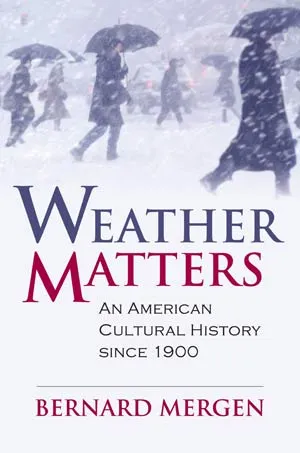
Weather Matters
Bernard Mergen Weather Matters: An American Cultural History since 1900 University Press of Kansas 448 pages, 6 x 9 inches ISBN 978 0700616114
Available here →April 10, 2009
20090410-mergen-bernard-weather-matters-american-cultural-history-2
The wide angle
The rest of this thread
Claudia Spohnholz
Bernard Mergen
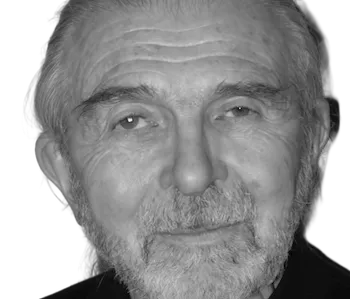
Bernard Mergen is Professor of American Studies Emeritus at George Washington University. He has held Fulbright teaching positions at Gothenburg University in Sweden, at the Free University of Berlin in Germany, and at the National University of Mongolia, and has lectured in more than a dozen other countries. From 1980 to 2004 Bernard Mergen was Senior Editor of American Studies International. In addition to Weather Matters and Snow in America, he is the author of more than one hundred articles and reviews on American labor and environmental history, the history of childhood and play, and the history of American Studies. He is currently writing a history of Pyramid Lake Nevada.
Pull this thread
What Americans feel about weather is taught to them by institutions.
Know something the rest of us don't?
Most threads on Rorotoko begin with our invitation. Any thread can begin with a proposal: you write it with the same prompts every thread answers, and we review it.
Propose a thread →