
Bernard Mergen
Weather Matters
I hope Weather Matters is a book that can be opened to any of its many subheadings and engage the reader. The chapters are topical more than chronological, and my argument for seeing weather as a system of systems builds by separate examples rather than in a linear manner. Either the introduction chapter or the conclusion chapter will give a sense of what the book provides. Perhaps my favorite section is the one on Edward Lorenz’s work on chaos and the “butterfly effect.” The sections on weather humor, on the early efforts to interest children in the activities of the Weather Bureau, on Jack Borden’s campaign to encourage “Sky Awareness,” on poems, novels, and paintings rich in weather images, and on the intersection of everyday weather and health are also good places to begin.
Every reader experiences a book differently.
Leafing through books, buying them, checking them out of a library, or reading them online requires different levels of commitment. Even a brief encounter with Weather Matters makes the reader part of the community of weather enthusiasts, taking them to a world beyond the satellite images of swirling clouds and the wind-tousled hair of on-camera weather reporters.
My personal experiences on a storm chase in the Midwest in June 2003 cover 14 pages in the final chapter. These convey, I hope, the many ironies and contradictions of weather mania. Professional storm chasing—taking paying customers on a kind of weather safari in search of tornadoes and other severe storms—began in the 1990s and has been popularized by television programs and movies such as Twister. While storm chasers can provide valuable information for public safety by reporting on storms in real-time, they are also part of disaster tourism; storm chasers are witnesses to other people’s tragedies.
Viewing a lightning-streaked sky over the Great Plains is the twenty-first century’s equivalent of a nineteenth century excursion to Niagara Falls, or a twentieth century trip to the Grand Canyon. Like in those experiences of search of the sublime, the traveler must ask what such an encounter means. Has the weather tourist learned anything that will change him or her for the better? Putting weather into American history means recognizing that the experience of the air we breathe, the clouds we watch, and the heat we suffer are inextricably part of the ways we think and talk about nature, beauty, and risk. Humans seek to control nature, but that control is often illusory. Because the tiniest factors in initial conditions, the flap of a butterfly’s wings, can have consequences as enormous as hurricanes, weather remains chaotic and unpredictable by even the most complex computer models.
The recognition and acceptance of this should make us humble. No one who watches a thunderstorm develop and climax in lightning and rain can doubt that, as the poet Wallace Stevens observed, nature has a penchant for gaudy display beyond any utilitarian purpose.
Weather Matters celebrates the aesthetics and rhetorics of weather. American weather, like America itself, is diverse and dynamic. It is an experiment in search of an hypothesis, a frontier in eternal conflict with settlement. We ignore the power of weather at our peril. I conclude with the reflection that the daily weather forecast is a call to prayer whose message is “heed our authority and the laws of nature, but expect to be surprised, and act for yourself.”
Editor: Erind Pajo
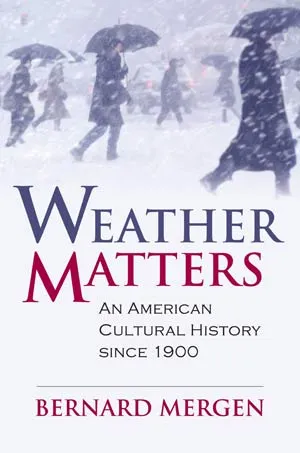
Weather Matters
Bernard Mergen Weather Matters: An American Cultural History since 1900 University Press of Kansas 448 pages, 6 x 9 inches ISBN 978 0700616114
Available here →April 10, 2009
20090410-mergen-bernard-weather-matters-american-cultural-history-3
A close-up
The rest of this thread

Claudia Spohnholz
Bernard Mergen
Bernard Mergen is Professor of American Studies Emeritus at George Washington University. He has held Fulbright teaching positions at Gothenburg University in Sweden, at the Free University of Berlin in Germany, and at the National University of Mongolia, and has lectured in more than a dozen other countries. From 1980 to 2004 Bernard Mergen was Senior Editor of American Studies International. In addition to Weather Matters and Snow in America, he is the author of more than one hundred articles and reviews on American labor and environmental history, the history of childhood and play, and the history of American Studies. He is currently writing a history of Pyramid Lake Nevada.
Pull this thread
What Americans feel about weather is taught to them by institutions that claim authority to speak on it.
Know something the rest of us don't?
Most threads on Rorotoko begin with our invitation. Any thread can begin with a proposal: you write it with the same prompts every thread answers, and we review it.
Propose a thread →