
Lawrence Rothfield
The Rape of Mesopotamia
One of the most poignant moments in The Rape of Mesopotamia comes when John Limbert, a diplomat and former Iranian hostage, was ordered to Baghdad by Colin Powell in the aftermath of the museum’s looting. Limbert had been appointed by Gen. Garner just a month or two before the war (remember, Garner’s postwar reconstruction organization was set up by the Bush administration only 8 weeks before the invasion). Garner had told Limbert then that he would be responsible for dealing with Iraq’s cultural ministries once the war ended. All he had to do was to make sure the ministries stayed in place and the Iraqis got paid—we would be gone in 8-10 weeks.
No one knew the names of the Iraqi officials Limbert was supposedly going to oversee; in fact, no one even knew where in Baghdad the Ministry of Culture was located.Before he could find out the answer to these questions, Limbert was shipped off to Kuwait, where he was isolated, along with the rest of Garner’s people, on a far corner of a military base. He remained there until finally, several weeks after the disaster, he got word to go to Baghdad to give a press conference at the museum reassuring the world that America was responding to the disaster. His driver did not have the museum on his map either, and pulled up to ask for directions. Glancing out the window at one of the many trashed government buildings, he read the name on its front: “Ministry of Culture.” “It had been picked to the bone by the looters to a degree I’ve never seen—not a stick of furniture, not a piece of wire, not a pipe remained,” Limbert told me.
The book ends before the surge restored a semblance of normality to Iraq. But the picture it paints of the dire situation on Iraq’s archaeological sites, and of the inexcusable neglect of this problem even now by both military and State Department officials, still holds true.As we turn our attention to Afghanistan, it is far from clear that there is either the will or the way on the part of Pentagon or State to do any better there. And while not the cradle of civilization, Afghanistan resembles Iraq in having an incredibly rich – and largely unexcavated – archaeological heritage.
Much of this has been lost since 2002: the British government, for example, just recently returned 3 tons of artifacts seized at London airports. As in Iraq, there is no question that the same networks that smuggle antiquities are also involved in insurgency. We know that Mohammed Atta, one of the 9/11 hijackers, tried to sell antiquities for the expressed purpose of raising money to buy an airplane.Beyond Afghanistan and Iraq, I hope Rape of Mesopotamia will spur conversations and encourage discussions about how our military can build into its force structure the capacity to secure important cultural sites and institutions. One lesson of the book is that this is not as easy to do as some might think.
Iraq’s National Museum was an enormous compound, and the country has 10,000 registered archaeological sites (with perhaps 90,000 more unregistered ones!). Iraq will take patience and persistence to make the changes needed. There are hopeful signs of progress already on this front, I should add. A Blue Shield organization – the cultural equivalent of the Red Cross – has finally been created in the US. The Defense Department has been working well with archaeologists on programs to raise the cultural awareness of troops heading overseas. And perhaps most important, the Army Field Manual that guides invasion planners now defines one of its “Essential Stability Tasks” as being to “protect and secure… cultural sites… museums; and religious sites.”
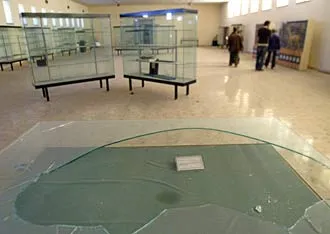
Figure 8 from the book: Smashed display case showing the base of the Vase of Warka, which was stolen and later recovered in pieces. (Photo courtesy of Joanne Farchakh Bajjaly, archaeologist-journalist.)
Editor: Erind Pajo
The Rape of Mesopotamia
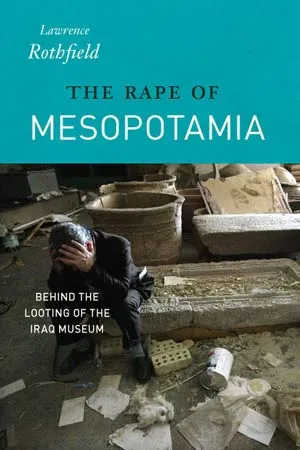
Lawrence Rothfield The Rape of Mesopotamia: Behind the Looting of the Iraq Museum University of Chicago Press228 pages, 6 x 9 inches ISBN 978 0226729459
Available here →May 11, 2009
20090511-rothfield-lawrence-rape-mesopotamia-looting-iraq-museum-3
A close-up
The rest of this thread

Hannah Rothfield
Lawrence Rothfield
Lawrence Rothfield is associate professor of English and comparative literature at the University of Chicago, where he co-founded the Cultural Policy Center. He is the editor of Unsettling “Sensation”: Arts Policy Lessons from the Brooklyn Museum of Art Controversy and Antiquities Under Siege: Cultural Heritage Protection After the Iraq War.
Pull this thread
Iraq's antiquities were pillaged for structural reasons, and most of the people involved acted in good faith.
Know something the rest of us don't?
Most threads on Rorotoko begin with our invitation. Any thread can begin with a proposal: you write it with the same prompts every thread answers, and we review it.
Propose a thread →