
Lawrence Rothfield
The Rape of Mesopotamia
It is a pretty twisted professional path that leads a cultural critic like me to become an expert on the history of the Army’s Civil Affairs division, fluent in the alphabet soup of military acronyms, and conversant in the legal niceties of the 1954 Hague Convention for the protection of Cultural Property in the Event of Armed Conflict. But one branch of cultural studies has always been interested in the ways in which culture is policed. Edward Said, my dissertation advisor, had blazed the path for this kind of work, and I was trying, in the years before the war, to build on his example by starting a research center on cultural policy at the University of Chicago. The policies we were analyzing were domestic, not international, and I had paid little attention to the problem of antiquities looting and smuggling—a huge policy concern even for countries not at war.
So it was with a mixture of chagrin and dismay that I learned from the New York Times that my colleague, the great Mesopotamian archaeologist McGuire Gibson, had met in January 2003 with postwar planners at the Pentagon and the State Department, to no avail. Had I not been asleep at the wheel I might have gotten involved, might have made a difference myself. I simply had failed to consider that policies, organizations, and leadership to protect cultural heritage might be so weak that the museum and sites could be left unsecured.
There is a body of law and commentary, including that 1954 Hague Convention, that is supposed to take care of, police in the good way, heritage that is threatened during and following conflict.
As my book shows, this international legal regime does not take account of the problem posed when it is civilian looters, and not soldiers, who are ripping artifacts from museum cases or the ground. Worse still, by obfuscating the distinction between civilian and military pillaging, the laws created opportunities for misunderstanding between archaeologists and war-planners that led advocates believing wrongly that their concerns had been heeded.
There also is a body of theory and, indeed, a very robust discussion under way, about who should own antiquities, about whether they should be returned to their countries of origin, and about the adequacies or inadequacies of the very concept of cultural patrimony. James Cuno of the Art Institute of Chicago and Princeton philosopher Kwame Anthony Appiah have forcefully argued against what they call “retentionism” on the part of antiquities-rich nations, in favor of free trade. But it is striking that, as they make these arguments, we see, in Iraq, the results of a finders-keepers free market in its purest form.
As Rumsfeld said, referring in part to the reports that the museum had been looted, freedom is untidy.
The invasion, sweeping away a tyranny, made clear the vacuousness of the contemporary debates about patrimony. The looting showed that we all need to be thinking much more practically about how museums and sites can be secured. The military needs operationalizable plans, not abstract principles. What is the best strategy for bringing looting under control, what tools and forces can be mustered, and how can resources be found to pay for what needs to be done? The tank commander in Baghdad did not have the museum on his map, much less tear-gas or other anti-riot gear, because no one was thinking about these matters.
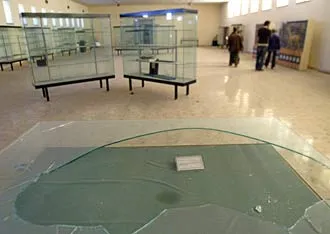
Figure 8 from the book: Smashed display case showing the base of the Vase of Warka, which was stolen and later recovered in pieces. (Photo courtesy of Joanne Farchakh Bajjaly, archaeologist-journalist.)
Editor: Erind Pajo
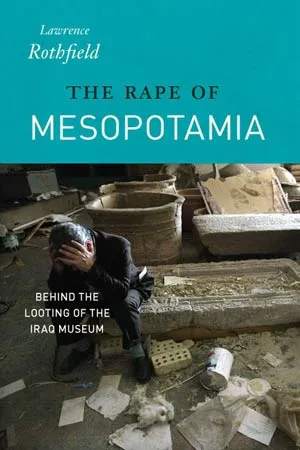
The Rape of Mesopotamia
Lawrence Rothfield The Rape of Mesopotamia: Behind the Looting of the Iraq Museum University of Chicago Press 228 pages, 6 x 9 inches ISBN 978 0226729459
Available here →May 11, 2009
20090511-rothfield-lawrence-rape-mesopotamia-looting-iraq-museum-2
The wide angle
The rest of this thread
Hannah Rothfield
Lawrence Rothfield
Lawrence Rothfield is associate professor of English and comparative literature at the University of Chicago, where he co-founded the Cultural Policy Center. He is the editor of Unsettling “Sensation”: Arts Policy Lessons from the Brooklyn Museum of Art Controversy and Antiquities Under Siege: Cultural Heritage Protection After the Iraq War.
Pull this thread
pulls againstpulls alongside
Iraq's antiquities were pillaged for structural reasons, and most of the people involved acted in good faith.
Against AG · In research universities the best scholars make the best leaders, and a hospital should be led by a doctor. On: Institutional outcomes are produced by structural design rather than by the qualities of the individuals inside
Against KF · Indigenous North America is a 20,000-year record of invention whose architecture stands comparison with medieval Europe's. On: Moral evaluation of past actors belongs inside scholarly explanation of them
Against AG · Organizational toxicity is a clinical condition that spreads like a contagion, and it is treatable. On: Institutional outcomes are produced by structural design rather than by the qualities of the individuals inside
Against AS · A social worker's finding of neglect is as factual as a doctor's reading of a blood-pressure number. On: Moral evaluation of past actors belongs inside scholarly explanation of them
Alongside RB · The American trial is dying from the bureaucratic and market structures around it, and that death is not inevitable. On: Institutional outcomes are produced by structural design rather than by the qualities of the individuals inside
Alongside JS · The judgment of history is a fantasy, and history renders no verdict at all, only a record of contention. On: Moral evaluation of past actors belongs inside scholarly explanation of them
Alongside DD · A large dealer bank fails by one mechanical sequence, a run by its overnight lenders, whatever caused the crisis. On: Institutional outcomes are produced by structural design rather than by the qualities of the individuals inside
Alongside DW · Florentine humanism owed far more to medieval traditions than has been recognized, which is why Savonarola captivated the city. On: Moral evaluation of past actors belongs inside scholarly explanation of them
Know something the rest of us don't?
Most threads on Rorotoko begin with our invitation. Any thread can begin with a proposal: you write it with the same prompts every thread answers, and we read it.
Propose a thread →