
Lawrence Rothfield
The Rape of Mesopotamia
The Rape of Mesopotamia is about the series of missteps, missed opportunities, and miscommunications that led to the massive looting of Iraq’s cultural heritage after the U.S. invasion in 2003. Most people know about the looting of the Iraq Museum, but horrific as that was, the subsequent years-long pillaging of thousands of Mesopotamian archaeological sites under the nose of occupation authorities was even worse.
Most people ask how such a thing could happen, as if that were merely a rhetorical question. After all, archaeologists say, we told the military looting would occur. That is true – in fact, the military, the Pentagon, and even the State Department’s point man Ryan Crocker were all told. None of them acted to prevent the disaster. Understanding why not is not a simple matter. I interviewed dozens of soldiers, bureaucrats, war planners, archaeologists, and collectors, ranging from the Pentagon official in charge of post-combat humanitarian assistance to the commander of the tank unit who was told to approach the museum to investigate reports of looting.
The story that emerged did include some incompetence and indifference. For the most part, however, those involved in the disaster were acting in good faith and with the best of motives. The looting of Iraq’s national museum and archaeological sites stemmed from deeper causes: the war fighting posture of the American military since World War II; the international framework of conventions for the protection of cultural property in times of armed conflict; the very American refusal to recognize culture as a sector like health, education, or energy, requiring the attention of policymakers; the focus of cultural heritage NGOs on conserving and developing sites rather than on securing them; and the absence of long-term relationships between archaeologists and the military that might have made it easier for advocates to put their case to those in a position to have done something.
I’d like readers to think of this book as something like Thomas Ricks’ Fiasco—but Fiasco for Cultural Heritage.
It is contemporary history with a critical edge, or if you like, political journalism. As with Ricks’ book, I hope readers will come away from mine not just appalled but better informed about what needs to be done to make sure that this disaster is never repeated.
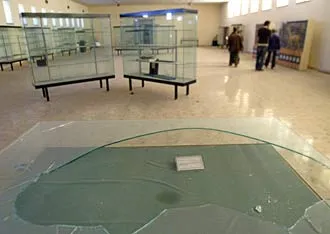
Figure 8 from the book: Smashed display case showing the base of the Vase of Warka, which was stolen and later recovered in pieces. (Photo courtesy of Joanne Farchakh Bajjaly, archaeologist-journalist.)
Editor: Erind Pajo
The Rape of Mesopotamia
Lawrence Rothfield The Rape of Mesopotamia: Behind the Looting of the Iraq Museum University of Chicago Press 228 pages, 6 x 9 inches ISBN 978 0226729459
Available here →May 11, 2009
20090511-rothfield-lawrence-rape-mesopotamia-looting-iraq-museum-1-1
In a nutshell
The rest of this thread

Hannah Rothfield
Lawrence Rothfield
Lawrence Rothfield is associate professor of English and comparative literature at the University of Chicago, where he co-founded the Cultural Policy Center. He is the editor of Unsettling “Sensation”: Arts Policy Lessons from the Brooklyn Museum of Art Controversy and Antiquities Under Siege: Cultural Heritage Protection After the Iraq War.
Pull this thread
Iraq's antiquities were looted for structural reasons, not from incompetence or indifference.
Know something the rest of us don't?
Most threads on Rorotoko begin with our invitation. Any thread can begin with a proposal: you write it with the same prompts every thread answers, and we review it.
Propose a thread →