
Don Lincoln
The Quantum Frontier
In the fall of 2008, the world’s largest particle accelerator, the Large Hadron Collider, or LHC, began operations for the first time. Circulating beams of protons under the Swiss and French countryside, the accelerator generated worldwide excitement. A disappointing technical malfunction delayed collisions, but scientists expect to turn the machine back on in October.
It is only a couple of times in a lifetime that a new particle accelerator is launched that can explore an entirely different energy frontier. The Fermilab Tevatron was in 1983 – a quarter century ago. It is expected that the new LHC will dominate the research landscape for the next decade or two.
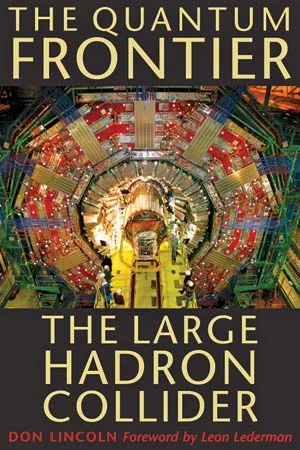
The Quantum Frontier: The Large Hadron Collider tells the story of this magnificent scientific instrument.
The book’s first chapter is about what we already know, the context for the exciting measurements we expect.
The second chapter reminds that we don’t actually know what the LHC will discover; this is truly terra incognita. However, I do discuss three of the interesting questions the LHC was built to investigate: (1) the elusive Higgs boson, sometimes called the God Particle; (2) supersymmetry, which predicts many new particles and would shed light on a few unanswered questions; and (3) the intriguing possibility that the smallest particles of which we are aware are themselves composed of even smaller particles. (These “smallest” particles are quarks and leptons—current theory treats both as containing nothing within them. The most familiar lepton is the electron; quarks are found inside the familiar proton and neutron.)The third chapter is about how particle accelerators work and about many of the amazing features of the LHC—including the temperature of the magnets (colder than space itself) and the vacuum in the accelerator (ten times better than the surface of the moon).
Chapter four is about how particle detectors work, and describes the four major detectors arrayed around the LHC’s ring. Two of these detectors include in excess of a hundred million distinct pieces each.
The fifth chapter takes a broader view. Staring deep into the cosmos, astronomers have found that fully 95% of the matter and energy in the universe is of totally unknown kinds. What might the LHC say about these mysteries?
There are other accelerators under consideration and upgrades of older ones. In addition, not all mysteries are found in a particle collider environment. Yet it is deeply intriguing that an accelerator here on Earth can perhaps answer mysteries that span the universe. The Quantum Frontier closes with a discussion of some of the broader issues that contemporary scientists are trying to tackle. It’s a heady time for physics enthusiasts; a paradigm-changing discovery could be just around the corner.
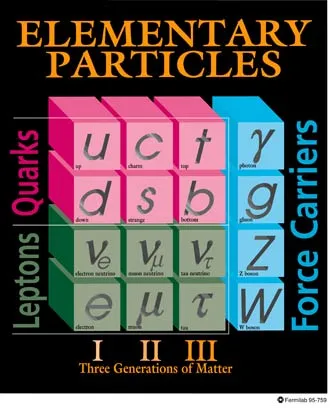
The chemical periodic table has been replaced by this one. The six quarks and six leptons are the tiniest particles yet discovered. The light blue column lists those particles that mediate three of the four forces (the still-hypothetical graviton is missing). Courtesy of Fermilab Visual Media Services.
Editor: Erind Pajo
The Quantum Frontier
Don Lincoln The Quantum Frontier: The Large Hadron Collider Johns Hopkins University Press 192 pages, 9 x 6 inches ISBN 978 0801891441
Available here →May 13, 2009
20090513-lincoln-don-quantum-frontier-large-hadron-collider-1-1
In a nutshell
The rest of this thread
Don Lincoln
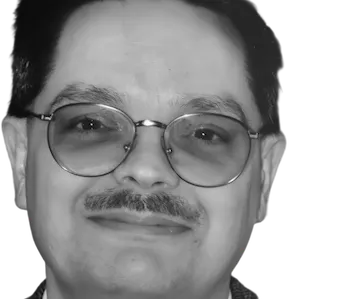
Don Lincoln is a senior scientist at Fermi National Accelerator Laboratory just outside Chicago and an adjunct professor at the University of Notre Dame. He splits his research time exploiting the mature data produced by the DZero experiment at Fermilab and in commissioning the CMS (or Compact Muon Solenoid) experiment at CERN. He is the author of over 300 technical papers, a few popular articles (e.g., in Analog: Science Fiction and Fact), a biweekly column in Fermilab Today, and two books on particle physics for general readers—the one described here and also Understanding the Universe: From Quarks to the Cosmos (World Scientific, 2004). He lives in the Chicago area with his family and a particularly hirsute cat.
Pull this thread
The LHC matters because its energy range is genuinely terra incognita, and nobody knows what is there.
Know something the rest of us don't?
Most threads on Rorotoko begin with our invitation. Any thread can begin with a proposal: you write it with the same prompts every thread answers, and we review it.
Propose a thread →