
Don Lincoln
The Quantum Frontier
We have come to understand that all the matter we have ever observed is made of a scant hundred chemical elements. The past century has shown that the atomic elements are themselves composed of even smaller objects: protons, neutrons and electrons. It is only in the last 30 years or so that we realized that protons and neutrons are made up of yet even smaller particles still, called quarks. Now we know that the matter of the universe is composed of just three particles: electrons and two different kinds of quarks, called up and down. This impresses the heck out of me… the entire universe is built from very intricate combinations of only three subatomic particles.
Finding the components of matter is only half the story. Something holds things together. There is but one force, gravity, which guides the planets in their stately orbits and also governs the breathtaking precision of an Olympic gymnast doing a vault. Another force, electromagnetism, is responsible for the glory of a brilliant sunset and for what makes impressive the karate expert’s swift strike through a board. Besides gravity and electromagnetism, two other forces have been discovered, simply called the strong and weak force. The strong force holds together the nucleus of atoms, while the weak force is responsible for many types of radioactivity.
That we can use three particles and four forces and, with a suitable instruction booklet, assemble the entire cosmos, is truly a triumph of modern science. But this is not to say that there remain no mysteries. In the course of trying to understand the universe, scientists discovered more particles… ones that seem unnecessary.
For instance, while the electron is a critical component of atoms, in the 1930’s a particle called the muon was discovered. The muon is in many ways just a heavy electron. But the muon is not found in ordinary matter. When confronted with the muon, the eminent physicist I.I. Rabi exclaimed, “Who ordered that?” Indeed, why there should be a “heavy electron” remains a mystery.
And the mystery goes deeper. In the mid 1970’s an even heavier electron-like particle was discovered, called the tau. Just to make things interesting, additional heavy quarks were found. The charm and top quark seem to be essentially heavy up quarks, while the strange and bottom quark seem to be heavy down quarks. Why there appears to be two additional (and heavier, which is probably an important clue) carbon copies of ordinary matter is not known to this day. (An historical tidbit: I was, and still am, a member of one of two teams who discovered the top quark in 1995. We continue to look for a fourth copy, thus far without success.)
When one thinks about the forces, the fact that static electricity and a magnet are really the same thing is not at all obvious. Newton’s realization that the forces that governed the heavens and the fictitious apple that hit him on the head were one and the same remains one of the most important insights of modern science. It only takes a modest amount of imagination to ask “Could the four forces of which we are aware be just different aspects of a single force?”
There are many questions for which one still does not receive a quick answer. Why do some particles have mass, while others don’t? Why are there three carbon copies of matter and not two or four? Or are there four, with the last one waiting for a clever researcher to reveal it? These and countless others might just be answered by the data the experimenters at the LHC will record. This is an exciting time in particle physics research!
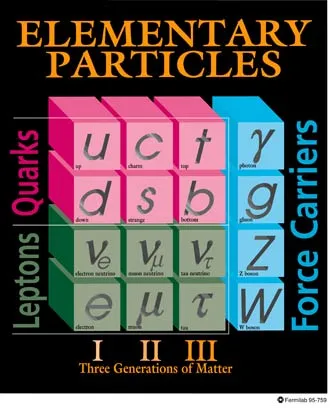
The chemical periodic table has been replaced by this one. The six quarks and six leptons are the tiniest particles yet discovered. The light blue column lists those particles that mediate three of the four forces (the still-hypothetical graviton is missing). Courtesy of Fermilab Visual Media Services.
Editor: Erind Pajo
The Quantum Frontier
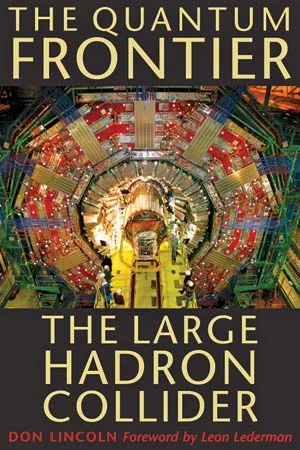
Don Lincoln The Quantum Frontier: The Large Hadron Collider Johns Hopkins University Press 192 pages, 9 x 6 inches ISBN 978 0801891441
Available here →May 13, 2009
20090513-lincoln-don-quantum-frontier-large-hadron-collider-2
The wide angle
The rest of this thread

Don Lincoln
Don Lincoln is a senior scientist at Fermi National Accelerator Laboratory just outside Chicago and an adjunct professor at the University of Notre Dame. He splits his research time exploiting the mature data produced by the DZero experiment at Fermilab and in commissioning the CMS (or Compact Muon Solenoid) experiment at CERN. He is the author of over 300 technical papers, a few popular articles (e.g., in Analog: Science Fiction and Fact), a biweekly column in Fermilab Today, and two books on particle physics for general readers—the one described here and also Understanding the Universe: From Quarks to the Cosmos (World Scientific, 2004). He lives in the Chicago area with his family and a particularly hirsute cat.
Pull this thread
The LHC matters because nobody knows what lies in its energy range.
Know something the rest of us don't?
Most threads on Rorotoko begin with our invitation. Any thread can begin with a proposal: you write it with the same prompts every thread answers, and we review it.
Propose a thread →