
Don Lincoln
The Quantum Frontier
While The Quantum Frontier is not a single-topic book, perhaps no question has received as much attention as that of the enigmatic Higgs boson. This undiscovered particle is always mentioned in the thousands of articles describing the LHC that appear in newspapers and popular science magazines. But precisely what this particle is, and why it’s important, is not always talked about. That’s a shame—without this particle or something equivalent, the universe would be a very different place.
The last couple of decades have taught us that the matter of the universe is made of unfamiliar subatomic particles called quarks and leptons. Two kinds of quarks (confusingly called up and down) make up the protons and neutrons of the nucleus of atoms, while the electron is the most familiar lepton. There are two carbon copies of these particles and all of the particles have radically different masses. The very light electron (the lightest of the class of particles that takes its name from leptos, the Greek word for light) has a mass of 0.05% that of a proton, while heaviest of them all, the weighty top quark (a copy of the up quark) has a mass 175 times heavier than the proton. Why should this be?
In the 1960’s, theoretical physicists were able to invent sensible theories that could predict many of the phenomena we observe. However these theories required subatomic particles to be massless—a distinctly not sensible idea.
To return sense from nonsense, a proposal was put forth in 1964. Peter Higgs integrated some earlier ideas with his own and suggested that there might be a previously-undetected energy field in the universe which has come to be called the Higgs field.
It is not obvious how the Higgs field can result in a particle, but a water analogy may help. Water is a liquid and fills up all of a container in which it is placed. One might call water “continuous,” as it is not at all trivial to go into a pool and find space “between water.” And yet water is made of molecules consisting of two hydrogen and one oxygen atoms (H 2 O). Water consists of tiny “smallest bits” of water and still looks continuous when viewed at human-size scales.
Similarly, the Higgs energy field consists of countless Higgs bosons. Finding such a boson is a crucial test of Peter Higgs’ idea and it is this search that is the most reported of the many things the LHC scientists are looking for. Reading The Quantum Frontier should give a very good idea of how scientists will know when they’ve found one. (If, indeed, Higgs bosons are there to be found at all.)Most books on physics written for the public concentrate on “big ideas” totally forgoing the common question “Yeah, but how do they know that?” That’s where The Quantum Frontier comes in. And while we all must trust experts at some level, it’s comforting to understand why it is that scientists have the confidence that they do. I hope that reading this book will enable a non-scientific reader to understand the principles that govern the LHC accelerator and the detectors that record the data. The experience should be like that of getting a glimpse under the hood of an exotic European race car.
I am sometimes asked why I write books for the public, when the time could be used more profitably to do research. It is a duty, indeed a privilege, to be able to share the excitement of frontier science with the general readers who are interested in the subject. There is another audience I have in mind as well. My path was not an obvious one, for neither my mother nor my father are scientifically-inclined. I am very grateful to my truly-wonderful parents. But they could not provide the kind of scientific role models some of my colleagues enjoyed in their childhoods. To indulge my youthful scientific curiosity I read. Prodigiously.
Nothing was exempt, although science fiction was my passion. As I got older, I was introduced to writings by Carl Sagan, and to Isaac Asimov’s popular science books, and to George Gamow. I was hooked… Science fiction is bound only by the writer’s imagination and the reader’s credulity. In science though, there is an answer. It is the universe itself.
Since then, I have devoted my life to the grand study of the cosmos—an endeavor that has spanned human history and will continue long after I have breathed my last. The science that I read now is more technical than what I read decades ago. But the spark started then, with the popular writings of a few who may have known of the impact they would have. Somewhere out there, there are potential young scientists, needing a similar kind of introduction to find their true calling. I write for them.
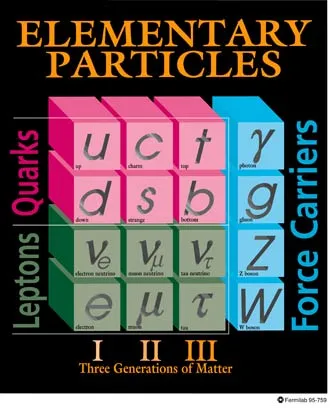
The chemical periodic table has been replaced by this one. The six quarks and six leptons are the tiniest particles yet discovered. The light blue column lists those particles that mediate three of the four forces (the still-hypothetical graviton is missing). Courtesy of Fermilab Visual Media Services.
Editor: Erind Pajo
The Quantum Frontier
Don Lincoln The Quantum Frontier: The Large Hadron Collider Johns Hopkins University Press 192 pages, 9 x 6 inches ISBN 978 0801891441
Available here →May 13, 2009
20090513-lincoln-don-quantum-frontier-large-hadron-collider-3
A close-up
The rest of this thread

Don Lincoln
Don Lincoln is a senior scientist at Fermi National Accelerator Laboratory just outside Chicago and an adjunct professor at the University of Notre Dame. He splits his research time exploiting the mature data produced by the DZero experiment at Fermilab and in commissioning the CMS (or Compact Muon Solenoid) experiment at CERN. He is the author of over 300 technical papers, a few popular articles (e.g., in Analog: Science Fiction and Fact), a biweekly column in Fermilab Today, and two books on particle physics for general readers—the one described here and also Understanding the Universe: From Quarks to the Cosmos (World Scientific, 2004). He lives in the Chicago area with his family and a particularly hirsute cat.
Pull this thread
The LHC matters because its energy range is genuinely terra incognita, and nobody knows what is there.
Know something the rest of us don't?
Most threads on Rorotoko begin with our invitation. Any thread can begin with a proposal: you write it with the same prompts every thread answers, and we review it.
Propose a thread →