
Cormac Ó Gráda
Famine
The book ranges from describing the horrors of famine in some detail to musing, with tempered hope, about the prospects of eliminating famine, at least in peacetime. I would hope that even a quick browse through Famine would alert the reader to the connection between what made communities vulnerable to famine in the past, and help one understand the prospects of making famine history in the future.It is almost a truism that all famines are caused by a combination of economic backwardness and human action.
Sometimes, as in medieval Europe or late Qing China, factors associated with the former, such as poor communications and the high cost of storage, have been more important. Sometimes, as with several well-known twentieth-century famines, human interventions have clearly mattered more.
It is tempting to simplify, and to blame famines long ago on Malthusian factors, and more recent famines on the likes of totalitarian despots such as Stalin, Hitler, or Mao. Now, undoubtedly, the balance has shifted over time from ‘natural’ to ‘man-made’ causes, from bad weather combined with poverty to human action (or inaction). Undoubtedly, too, the relative importance of these causes has been—or continues to be—controversial. And that goes for many famines, not least the Great Irish Famine.
The book ends with some mildly optimistic speculations about the prospects of ‘making famine history’ in the near future. I note, however, that past prognostications have rarely got it right. A notorious case in point is biologist Paul Ehrlich’s doomsday forecast. In the late 1960s, Ehrlich predicted that in the following decade ‘hundreds of millions of people…[were] going to starve to death in spite of any crash programs embarked upon now’.
Ehrlich got it almost exactly wrong. In the following decade fear of global overpopulation prompted hard-line (and high-profile) Malthusian writers to predict the ‘Great Die-Off’ in which some four billion people would perish. The Ethiopian famine of 1974 forced Wallace Aykroyd, a famine scholar, to add an epilogue to his book The Conquest of Famine, in which he tempered optimism with the hope that the knowledge and experience gained in Ethiopia would prove useful in relieving famines elsewhere in future.
It would thus be foolhardy to predict far into the future. In several respects, however, the outlook for the next decade or so is more hopeful today than in the past. The good news, as I argue in the final chapter, is that the huge increase in global living standards since 1900 and the accompanying globalization of disaster relief mean that poor but peaceful regions of the world are less at risk nowadays than even in the 1980s. It also helps that there are no Stalins, Hitlers, or Maos on the horizon. Nor is the current economic recession, though worrying and severe, likely to become a lasting one. After all, the big rises in world food prices in 2006-07, which led to serious rioting in many places, and which some commentators deemed a sign of things to come, are now almost forgotten.
Global food production per head is subject to fluctuation but it has been rising. Almost every country in the world, even the poorest, has already embarked on the transition towards lower fertility and smaller family size. Famine early warning systems are in place, and dozens of NGOs eager and ready to help. The prospects of avoiding famines across the globe during the next decade or so are probably better than they ever have been. Nonetheless, it would be foolhardy to rule out the return of famines of biblical proportions sometime in the future. The recurrence of major war, regional or international, can never be ruled out. Such an eventuality would mean that all bets about making famine history are off.
Editor: Erind Pajo
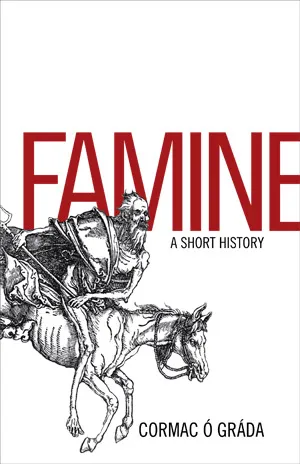
Famine
Cormac Ó Gráda Famine: A Short History Princeton University Press344 pages, 51/2 x 81/2 inches ISBN 978 0691122373
Available here →May 25, 2009
20090525-ograda-cormac-famine-short-history-3
A close-up
The rest of this thread

Cormac Ó Gráda
Cormac Ó Gráda is professor of economics at University College Dublin. His other books include Ireland: A New Economic History (Oxford, 1994), A Rocky Road: The Irish Economy since the 1920s (Manchester, 1997), Black ’47 and Beyond: The Great Irish Famine in History, Economy, and Memory (Princeton, 1999), and Jewish Ireland in the Age of Joyce: A Socioeconomic History (Princeton, 2006). He lives with his family in Dublin.
Pull this thread
Every famine is the product of economic backwardness and human action together.
Know something the rest of us don't?
Most threads on Rorotoko begin with our invitation. Any thread can begin with a proposal: you write it with the same prompts every thread answers, and we review it.
Propose a thread →