
Peter Conn
The American 1930s
With the exception only of the Civil War, Americans faced in the Depression of the 1930s the most wrenching and divisive domestic crisis in their history. An economic structure that had seemed unshakable simply collapsed, and neither experts nor ordinary citizens were ever sure why.
The political and economic debates of the decade have produced a long shelf of books, and the current financial slump has renewed interest in those controversies. However, the literature and art of the thirties have been less thoroughly documented. A few images – photos of soup kitchens and Dust Bowl migrants – have survived, which offer an important but selective and ultimately misleading version of the Depression years.
In fact, the 1930s were years of rich and diverse creativity, in which artists and writers responded to the crisis in a wide assortment of ways. In the imagination of the thirties, optimism competed with pessimism, and comedy co-existed with tragedy.
My book discusses well over a hundred novels, stories, plays, and paintings, offering one of the most comprehensive accounts of this decade ever published. In addition to fiction, the book refers to much of the nonfiction writing of the period, including biographies, memoirs, and works of history, and quite a few of the Pulitzer Prize winners.
Among the men and women whose work is explored in The American 1930s are William Faulkner, F. Scott Fitzgerald, Gertrude Stein, Dorothea Lange, John Dos Passos, Pearl S. Buck, Carl Sandburg, Zora Neale Hurston, Thomas Hart Benton, Langston Hughes, Grant Wood. I also include a host of less familiar writers and artists.
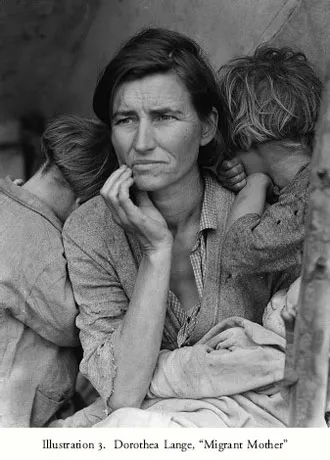
Illustration 3. Dorothea Lange, "Migrant Mother"
Editor: Erind Pajo

The American 1930s
Peter Conn The American 1930s: A Literary History Cambridge University Press 280 pages, 9 x 6 inches ISBN: 978 0521734318
Available here →June 12, 2009
20090612-conn-peter-american-1930s-literary-history-1-1
In a nutshell
The rest of this thread

Jessica Wolfe
Peter Conn
Peter Conn is Professor of English at the University of Pennsylvania. His publications include The Divided Mind: Ideology and Imagination in America, 1898-1917 (published by Cambridge University Press in 1983 and reissued in paperback in 1988 and 2008), Literature in America (Cambridge, 1989), which was a main selection of Associated Book Clubs in the United Kingdom, and Pearl S. Buck: A Cultural Biography (Cambridge, 1996, paperback 1998), which received the Athenaeum Award, was included among the five finalists for the National Book Critics Circle award in biography, and was chosen as a “Notable Book” by the New York Times. Conn has been a Fellow of the John Simon Guggenheim Foundation, has received several awards for distinguished teaching, directed National Endowment for the Humanities seminars for college and high school teachers, and was the recipient of an NEH Humanities Focus grant.
Pull this thread
Depression-era American culture turned to the past more than to radicalism.
Know something the rest of us don't?
Most threads on Rorotoko begin with our invitation. Any thread can begin with a proposal: you write it with the same prompts every thread answers, and we review it.
Propose a thread →