
Peter Conn
The American 1930s
Many browsing readers – this is certainly true for me – would take a look at a book’s introduction. Here, the introduction gives a relatively full explanation of what I am up to in my book.
On the other hand, a reader might take a first look at the epilogue. Here, the Epilogue does more than review and survey what the earlier chapters have accomplished. I recall the New York World’s Fair of 1939-1940. The Fair’s inspirational symbolism was calculated and timely. Fully ten years after the Crash, the nation’s crippled economy continued to resist the solutions of the New Deal. The Fair, mainly intended to generate revenue for the city, turned into one of the great public events of the decade. For a few hours at least, visitors could leave behind the dreariness of unemployment and class struggle and enter an ideal world of rational planning in which social problems found elegant solutions. As conceived by the corporate leaders of General Motors, General Electric, and Kodak, among others, America's future would be orderly, clean, lily-white, and free of smog and slums.
It was called “The World of Tomorrow,” but in fact the World’s Fair brought the past and future together, often in unexpected ways. While the Fair was famous for its predictions of the technological marvels that lay in store in the decades to come, it was officially conceived as a celebration of the hundred-and-fiftieth anniversary of Washington’s inauguration in New York. The Fair counseled hope, but the hope was rooted in nostalgia: like its sleek, modern buildings, America would rise out of stagnation and discover a prosperous carefree future – a future that bore some striking resemblances to the past.
For example, visitors to the Perisphere – one of the Fair’s two iconic buildings, along with the Trylon – stood on two rotating platforms that circled “Democracity 2039.” The city of the future would be small in scale, set in wooded preserves, with machinery subordinated to human use. Upon inspection, the city as foreseen by the designers of Democracity was less urban than suburban, despite disclaimers to the contrary. It was a dream of the past decked out in the deceptive glamour of the future.
In short, the World’s Fair offers a compressed illustration of the argument I make throughout the book. The turbulence of the Depression decade impelled Americans toward a sustained and lively inquiry into the past, as a way of finding answers to the questions posed by the longest economic crisis in the nation’s history.
Taken most generally, my book argues against the simplification of history. Any attempt to recover the past must acknowledge that no single explanation or formula will be sufficient to encompass the multifarious motives and choices through which the men and women of vanished decades defined themselves.
In that sense, the particular example of the American 1930s merely exemplifies a larger point. To see the thirties exclusively as “the red decade” is to reduce a complex palette to a monotone. I quote in the book the journalist Robert Bendiner, whose family lived a hand-to-mouth existence through the American thirties: “It has always seemed to me fatuous to fix a single label on a whole decade – as though the Nineties were gay for immigrant ladies in the garment sweatshops of Manhattan or the Twenties stood for hot jazz in the mind of Calvin Coolidge.”
In other words, instead of ignoring or manipulating the past to fit the presuppositions of two or three hackneyed adjectives, it is important to address the facts and texts of any historical period and follow their lead. This is what I have tried to do in The American 1930s. Again, the New Yorker review captures the book well: “despite the strain of the Depression, the United States in the thirties was ‘a place of enormous ideological and imaginative complexity’.”
(This interview incorporates excerpts from The American 1930s: A Literary History, reproduced here with permission of Cambridge University Press.)
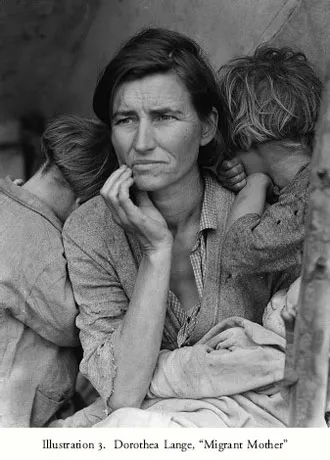
Illustration 3. Dorothea Lange, "Migrant Mother"
Editor: Erind Pajo

The American 1930s
Peter Conn The American 1930s: A Literary History Cambridge University Press 280 pages, 9 x 6 inches ISBN: 978 0521734318
Available here →June 12, 2009
20090612-conn-peter-american-1930s-literary-history-3
A close-up
The rest of this thread

Jessica Wolfe
Peter Conn
Peter Conn is Professor of English at the University of Pennsylvania. His publications include The Divided Mind: Ideology and Imagination in America, 1898-1917 (published by Cambridge University Press in 1983 and reissued in paperback in 1988 and 2008), Literature in America (Cambridge, 1989), which was a main selection of Associated Book Clubs in the United Kingdom, and Pearl S. Buck: A Cultural Biography (Cambridge, 1996, paperback 1998), which received the Athenaeum Award, was included among the five finalists for the National Book Critics Circle award in biography, and was chosen as a “Notable Book” by the New York Times. Conn has been a Fellow of the John Simon Guggenheim Foundation, has received several awards for distinguished teaching, directed National Endowment for the Humanities seminars for college and high school teachers, and was the recipient of an NEH Humanities Focus grant.
Pull this thread
The through line of Depression-era American culture was a sustained turn to the past, not radicalism.
Know something the rest of us don't?
Most threads on Rorotoko begin with our invitation. Any thread can begin with a proposal: you write it with the same prompts every thread answers, and we review it.
Propose a thread →