
Walter W. McMahon
Higher Learning, Greater Good
Higher Learning, Greater Good is the first book to systematically identify and develop the evidence necessary to measure comprehensively the benefits of higher education and to estimate their economic value.
The benefits of higher learning include not only increased earnings, access to jobs, and economic growth effects, but also non-market private benefits beyond earnings to individuals and their families and external benefits to the society.
The non-market private benefits are, for example, better health, better spousal and child health, greater longevity, child cognitive development, and increased happiness. The value of these private benefits estimated by the income-equivalent method is substantial, and approximately equal to the earnings benefits.
The non-market social benefits are different. They are benefits to others in the society and to future generations. They include the contribution of higher education graduates to the improved operation of democratic, civic, and charitable institutions, to human rights, to political stability, to lower crime rates, to social capital and social cohesion, to the generation and adaptation of new ideas, and so forth. They also are substantial; estimated to be another 40% beyond the private earnings benefits.
The book also evaluates the returns to university-based research – its interaction with the education of Masters, PhD, and professional students, and the spillover effects as the new ideas and new technologies generated by research and the education of graduate students are embodied in human capital through the education of undergraduates.
The total measured market plus non-market benefits of higher learning can then be evaluated in relation to institutional costs, which have been rising, but also in relation to the total costs that include the forgone earnings costs which have been flat. The analysis leads to more meaningful criteria as to whether there is underinvestment, overinvestment, or about the right level of investment in higher education by individuals, families, and government.
In terms of policy, the book addresses the main source of the worsening economic and social plight of the American middle class. Higher Learning, Greater Good develops the only key major policy that can eventually correct the problem of a whole class of people currently excluded from the benefits of growth and the related problem of rising inequality: increased investment in improved education and skill levels. Simultaneously, this policy will foster higher economic growth and development.
Editor: Erind Pajo
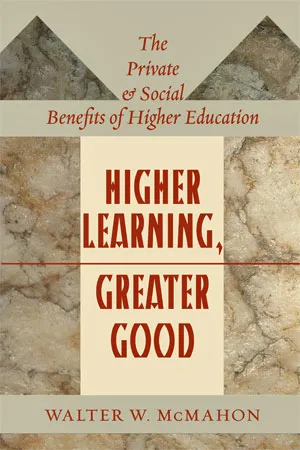
Higher Learning, Greater Good
Walter Mc Mahon Higher Learning, Greater Good: The Private and Social Benefits of Higher Education Johns Hopkins University Press 432 pages, 9 x 6 inches ISBN 978 0801890536
Available here →July 1, 2009
20090701-mcmahon-walter-higher-learning-private-social-benefits-education-1-1
In a nutshell
The rest of this thread

Walter W. McMahon
Walter W. McMahon is Professor of Economics and Professor of Education Emeritus at the University of Illinois at Urbana-Champaign. He is an expert on the economics of education and well known internationally, author of Education and Development: Measuring the Social Benefits (Oxford University Press, 2002), and of numerous articles, including “An Analysis of Education Externalities and Development in the Deep South,” in Contemporary Economic Policy, and “Education Finance Policy; Financing the Non-Market and Social Benefits,” in the Journal of Education Finance. Professor McMahon has consulted widely in developing and European countries for the World Bank, USAID, OECD, and other governments and international agencies. He has been at the Brookings Institution and a Fellow at universities in the United Kingdom, France, the Netherlands, and Sweden. He is a member of the National Academy of Sciences and past Chair of the Faculty Advisory Committee of the Illinois Board of Higher Education.
Pull this thread
Most of the return on higher education is invisible to the usual accounting.
Know something the rest of us don't?
Most threads on Rorotoko begin with our invitation. Any thread can begin with a proposal: you write it with the same prompts every thread answers, and we review it.
Propose a thread →