
Walter W. McMahon
Higher Learning, Greater Good
Chapter 5 adopts a rigorous definition of what externalities are, identifies a wide range of external social benefits of higher education, presents and evaluates the empirical evidence for each, and uses two of the four ways available for estimating their economic value.
There are a few economists, who appear to be in the minority, who deny that any external social benefits at all exist at the higher education level. This chapter shows how some can arrive at this view. The table on pages 233-4 lists the range of external social benefits of higher education beyond earnings, the evidence for each, and estimates of their total value. This value is estimated to be an amount above and beyond earnings that is on average about 40% of the earnings benefits. Since some of the earnings of higher education graduates also include a measurable portion that can be attributed to the education of others including those in prior generations, there is an additional overlap with earnings. This all implies that the external social benefits from higher education are substantial. But there must be a degree of public support if these external benefits are to be realized.
The book also has policy implications at the campus level. Currently, policy at campus and university levels is moving toward further privatization of revenue sources. This involves raising tuition and fees, and seeking private industrial support for research. Institutions are forced in this direction as they need to replace public support that is being cut back at the state level – Federal support for institutions has been largely nonexistent, apart from support for research.
The benefits from higher education that are external social benefits as a percent of the total benefits offers a new basic guide to the extent to which privatization should go and still be consistent with achieving overall economic efficiency, properly defined to include external benefits.
Chapters 7 and 8 discuss policy options as well as new strategies for supplemental financing of higher education.
Higher Learning, Greater Good is directed to a general but intelligent audience, not to economists or specialists. It can be easily understood by anyone who has had high school algebra. But as specialists look further into the book they will see that it has broad implications for the coherence of the field.
This book develops the implications of modern human capital theory as a coherent framework for the analysis of the efficiency of the contributions of higher education and research to human welfare. These implications include familiar market outcomes but also less familiar non-market private and social benefits beyond earnings. Delayed direct and indirect impacts of higher education which compound over time are dynamic aspects that define the central role of human capital formation in broader economic development.
The significance for current policy is that it develops the evidence for private and social non-market benefits that have been overlooked. This has contributed to market failure and underinvestment in higher education by families and by government. Both standard and new total social rates of return presented in the book confirm this. The underinvestment has led to a lack of sufficient skills to adapt to new technologies and to the international outsourcing of jobs that describes the current plight of the middle class. The current temporary recession only makes the same problem worse.
Higher Learning, Greater Good also has implications for academic policy at the campus level. For example, national priorities that stress patenting and contributions by certain fields to growth influence allocations of resources among disciplines. But when the indirect effects of higher education on growth that come through its contributions to democratization, political stability, and trade are considered, then the indirect contributions to growth of fields like political science, constitutional law, and foreign languages become more apparent.
Editor: Erind Pajo
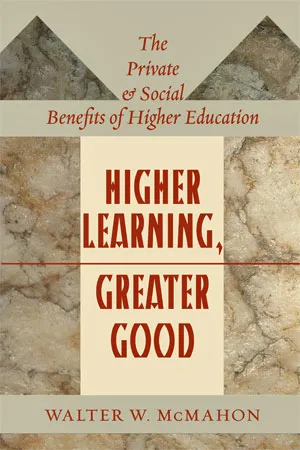
Higher Learning, Greater Good
Walter Mc Mahon Higher Learning, Greater Good: The Private and Social Benefits of Higher Education Johns Hopkins University Press 432 pages, 9 x 6 inches ISBN 978 0801890536
Available here →July 1, 2009
20090701-mcmahon-walter-higher-learning-private-social-benefits-education-3
A close-up
The rest of this thread

Walter W. McMahon
Walter W. McMahon is Professor of Economics and Professor of Education Emeritus at the University of Illinois at Urbana-Champaign. He is an expert on the economics of education and well known internationally, author of Education and Development: Measuring the Social Benefits (Oxford University Press, 2002), and of numerous articles, including “An Analysis of Education Externalities and Development in the Deep South,” in Contemporary Economic Policy, and “Education Finance Policy; Financing the Non-Market and Social Benefits,” in the Journal of Education Finance. Professor McMahon has consulted widely in developing and European countries for the World Bank, USAID, OECD, and other governments and international agencies. He has been at the Brookings Institution and a Fellow at universities in the United Kingdom, France, the Netherlands, and Sweden. He is a member of the National Academy of Sciences and past Chair of the Faculty Advisory Committee of the Illinois Board of Higher Education.
Pull this thread
Underinvestment in higher education, not trade, is why middle-class real earnings have been flat or falling since 1980.
Know something the rest of us don't?
Most threads on Rorotoko begin with our invitation. Any thread can begin with a proposal: you write it with the same prompts every thread answers, and we review it.
Propose a thread →