
Walter W. McMahon
Higher Learning, Greater Good
64% of the US population — which includes the middle class — has a high school education or less, a pattern also found in the UK and EU countries. This group has had flat and now declining real earnings since 1980. During this same period those with a college education have experienced a 48% to 57% increase in their real earnings. The less well-educated middle class has not shared in the benefits of freer trade and economic growth, producing a political protectionist reaction.
The benefits of growth do not trickle down if those below do not have the necessary skills. Those with less education are confined to occupations where demand is expected to continue to fall. The latter generates surpluses of workers, thereby holding down wages and earnings growth.
The book develops the evidence showing that in occupations where demand is rising two to four years of higher education or more are needed. (The only exception is home health care). I weigh higher education policy options for support of increased access and affordability for two and four year college degrees.
Conceptually, as a systematic human capital formation analysis of higher education and higher education policy, the book has a chance of displacing what Charles Clotfelter referred to as “the familiar, but curious, economics of higher education” (Journal of Economic Perspectives, 1999).
The framework developed in the book is one for achieving overall economic efficiency – not just internal efficiency but also external efficiency. This implies a degree of accountability for not just instructional units but for the more ultimate higher education outcomes that motivate most faculty. A modern human capital perspective also offers new insights into central higher education policy issues such as the appropriate degree of access, affordability, accountability, and the degree of privatization in funding.
Probably the book’s most important conceptual innovation is that it is not static, but instead analyzes dynamic lags in the process in a way consistent with modern endogenous growth theory and empirical research. When only a static perspective is taken, and when indirect effects from higher education operating through political stability, trade, new ideas, and other intervening variables are ignored, many or most social benefits of higher education are overlooked. This leads to significant public underinvestment in student financial aids and in institutional support of higher education.
The mainstream of modern economic growth and development theory now tends to incorporate human capital formation in a central role. This is typical of the work by Robert Lucas and Paul Romer, for example. In what they refer to as “endogenous growth,” the creation and adaptation of new ideas and the formation of human capital are determined inside the system and are no longer benefits that fall in an unexplained way like “manna from heaven.” This new work underlies the popular concepts of the “knowledge-based economy” and “knowledge-based growth.” This new theoretical framework on the sources of growth and development gives education – higher education included – a central role. But, oddly, these developments have not been brought into the systematic analysis of higher education and higher education policy.
Editor: Erind Pajo
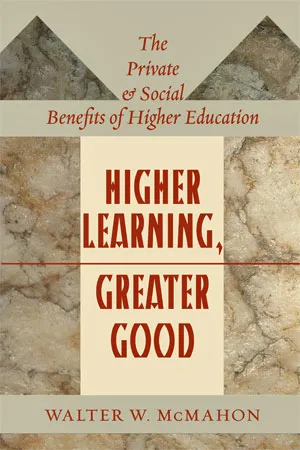
Higher Learning, Greater Good
Walter Mc Mahon Higher Learning, Greater Good: The Private and Social Benefits of Higher Education Johns Hopkins University Press 432 pages, 9 x 6 inches ISBN 978 0801890536
Available here →July 1, 2009
20090701-mcmahon-walter-higher-learning-private-social-benefits-education-2
The wide angle
The rest of this thread

Walter W. McMahon
Walter W. McMahon is Professor of Economics and Professor of Education Emeritus at the University of Illinois at Urbana-Champaign. He is an expert on the economics of education and well known internationally, author of Education and Development: Measuring the Social Benefits (Oxford University Press, 2002), and of numerous articles, including “An Analysis of Education Externalities and Development in the Deep South,” in Contemporary Economic Policy, and “Education Finance Policy; Financing the Non-Market and Social Benefits,” in the Journal of Education Finance. Professor McMahon has consulted widely in developing and European countries for the World Bank, USAID, OECD, and other governments and international agencies. He has been at the Brookings Institution and a Fellow at universities in the United Kingdom, France, the Netherlands, and Sweden. He is a member of the National Academy of Sciences and past Chair of the Faculty Advisory Committee of the Illinois Board of Higher Education.
Pull this thread
Underinvestment in higher education, not trade, is why middle-class real earnings have been flat or falling since 1980.
Know something the rest of us don't?
Most threads on Rorotoko begin with our invitation. Any thread can begin with a proposal: you write it with the same prompts every thread answers, and we review it.
Propose a thread →