
John Kricher
The Balance of Nature
The existence of a balance of nature has been a dominant part of Western philosophy since before Aristotle. But the science of ecology and evolutionary biology together demonstrate that there is no balance of nature—not today and not at anytime in Earth’s long history. The paradigm is based on belief, not data; it has no scientific merit.
The Balance of Nature traces how and why the balance of nature assumption remained prevalent in the public mind and in ecological research until quite recently. By presenting a brief overview of the history of ecology and evolutionary biology, I show how ecologists now understand that the balance of nature was really a perception rather than a fact.
Nature is constantly in flux varying in scales of space and time, and most of that flux is due entirely to natural causes.
At this time of extraordinary human influence on Earth’s ecosystems and biota, I argue that it is essential for humanity to understand how evolution occurs and why ecology is far more dynamic than static.
With that information it will then be hopefully possible to formulate policies of ecological ethics that will help humanity act as responsible stewards of the planet—even in a time of climate change and loss of natural ecosystems.
I conclude with what I believe to be a tightly reasoned appeal to adopt a materialistically based, scientific view of nature and, from that understanding, move toward sound decisions about how best to ensure the continued health of the planet’s ecosystems.
Editor: Erind Pajo

The Balance of Nature
John Kricher The Balance of Nature: Ecology’s Enduring Myth Princeton University Press 252 pages, 9 x 9 inches ISBN 978 0691138985
Available here →July 17, 2009
20090717-kricher-john-balance-nature-ecology-enduring-myth-1-1
In a nutshell
The rest of this thread
Martha Vaughan
John Kricher
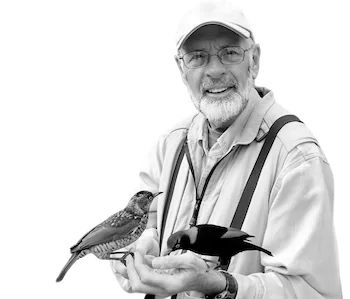
John Kricher is the A. Howard Meneely Professor of Biology at Wheaton College, a Fellow in the American Ornithologists Union, and member of the Science Advisory Committee of the Council of the Massachusetts Audubon Society. He has previously served as president of the Association of Field Ornithologists, the Wilson Ornithological Society, and the Nuttall Ornithological Club, and as a member of the board of directors for the Manomet Center for Conservation Sciences, the New Jersey Audubon Society, and the American Birding Association. Dr. Kricher has conducted Earthwatch-sponsored research on migrant birds on their wintering grounds in Belize, and led numerous trips to places including Cape May, Block Island, coastal New England, Arizona, the Pacific Northwest, Belize, Guatemala, Costa Rica, Peru, Ecuador, Galapagos Islands, Panama, and Trinidad. He has authored over 100 papers and articles in scientific journals as well as magazines and newspapers. Besides The Balance of Nature, Kricher’s books include Galapagos: A Natural History (Smithsonian Institution 2002; paperback Princeton 2006), four titles in the Peterson series, of which A Neotropical Companion has been translated into Spanish through the American Birding Association. John and his wife, Martha Vaughan, divide their time between Pocasset, Massachusetts, on Cape Cod and Sunbury, Georgia.
Pull this thread
There is no balance of nature, not now and not at any point in Earth's history.
Know something the rest of us don't?
Most threads on Rorotoko begin with our invitation. Any thread can begin with a proposal: you write it with the same prompts every thread answers, and we review it.
Propose a thread →