
John Kricher
The Balance of Nature
I actually began thinking about this book about two decades ago. I teach at a liberal arts college and I have had numerous fruitful interactions ranging from casual conversations with professors outside of my discipline to interdisciplinary course collaborations.
For example, I once taught a course with a philosophy professor on Evolution and Ethics. This got me to read extensively about such things as the naturalistic fallacy, for example. Right now I have a formal connection between my introductory course on Evolution and Ecology and a course taught by a professor of English, called “Empire, Race, and the Victorians.” The connection focuses on Darwin’s views of race.
So, with my generalist background in the liberal arts, I am drawn to make connections with other disciplines. The Balance of Nature attempts to do that by historically tracing the likely origin and propagation of the notion of balance of nature. The idea of a balance of nature was never based one jot on science but on teleological notions of how things “ought” to be.
One might almost count it among the multiple creation myths that characterize various human cultures.
I have always taught both a basic ecology course and various levels of evolution courses. When I initially approached ecology and evolution, as separate courses, the subject matter in each seemed fairly distinct from the other. I soon realized that distinction was false, a matter of scale. Evolution is ecology on a longer time scale. Ecology is vacuous without contextualizing it within evolution.
Back in the mid-1970s I thought of putting together a book of readings for ecology students that dealt with how evolution could inform ecology more directly than how it was represented in the dominant textbooks of the time. No publisher was interested.
When Ed Wilson published his sweeping book on Sociobiology in 1975 I felt as though ecology would be forced to embrace evolution in a manner similar to how Wilson brought animal social behavior into such a clear evolutionary light. Wilson’s book stirred controversy, because humans were included as though human social behavior evolved. Of course human social behavior evolves! But such a claim was anathema to many in academe at the time.
Meanwhile, ecologists did focus increasingly on evolution, and that was reflected in ecology texts. They began to apply more and more stochasticity to their analyses of ecosystem function, in particular to the analysis of the distribution of species within ecosystems.
I quickly realized that ecologists were moving away from equilibrium models. I realized as well that if there is little or no equilibrium attained in nature, there is no balance of nature, and that the term itself is misleading and meaningless.
I knew that the information ecologists were generating had broad implications for how the general public would perceive what it calls nature. As I did when conceiving another book, A Neotropical Companion, which is a broad overview of ecology of the American tropics, I thought that I could bring together an array of diverse information, all based on real science, that would synthesize into a cohesive volume. That’s how The Balance of Nature got started.
Editor: Erind Pajo
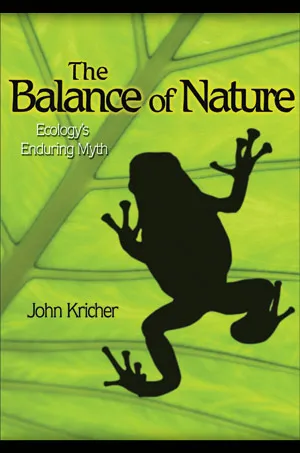
The Balance of Nature
John Kricher The Balance of Nature: Ecology’s Enduring Myth Princeton University Press 252 pages, 9 x 9 inches ISBN 978 0691138985
Available here →July 17, 2009
20090717-kricher-john-balance-nature-ecology-enduring-myth-2
The wide angle
The rest of this thread
Martha Vaughan
John Kricher
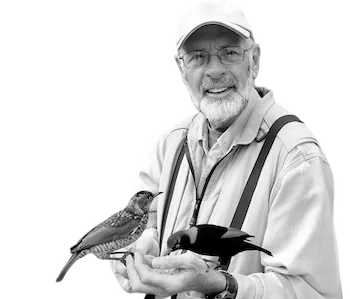
John Kricher is the A. Howard Meneely Professor of Biology at Wheaton College, a Fellow in the American Ornithologists Union, and member of the Science Advisory Committee of the Council of the Massachusetts Audubon Society. He has previously served as president of the Association of Field Ornithologists, the Wilson Ornithological Society, and the Nuttall Ornithological Club, and as a member of the board of directors for the Manomet Center for Conservation Sciences, the New Jersey Audubon Society, and the American Birding Association. Dr. Kricher has conducted Earthwatch-sponsored research on migrant birds on their wintering grounds in Belize, and led numerous trips to places including Cape May, Block Island, coastal New England, Arizona, the Pacific Northwest, Belize, Guatemala, Costa Rica, Peru, Ecuador, Galapagos Islands, Panama, and Trinidad. He has authored over 100 papers and articles in scientific journals as well as magazines and newspapers. Besides The Balance of Nature, Kricher’s books include Galapagos: A Natural History (Smithsonian Institution 2002; paperback Princeton 2006), four titles in the Peterson series, of which A Neotropical Companion has been translated into Spanish through the American Birding Association. John and his wife, Martha Vaughan, divide their time between Pocasset, Massachusetts, on Cape Cod and Sunbury, Georgia.
Pull this thread
pulls againstpulls alongside
There is no balance of nature, not now and not at any point in Earth's history.
Against BM · De-extinction is a failure to learn what drove species extinct, and it threatens the wildness it claims to save. On: There is a nature independent of human action that environmental thought can appeal to
Against CS · Turtles are as endangered as primates, and their apparent invulnerability is exactly what makes them easy to take. On: There is a nature independent of human action that environmental thought can appeal to
Alongside JI · Conservation is one of the routes by which capitalist worldviews became environmental, not a defense of nature against capitalism. On: There is a nature independent of human action that environmental thought can appeal to
Alongside PW · Nature has ended, and environmentalism should welcome it, managing wildness rather than fencing it off. On: There is a nature independent of human action that environmental thought can appeal to
Alongside TM · The concept of nature has had its day and is now an obstacle. On: There is a nature independent of human action that environmental thought can appeal to
Alongside EO · Fire, heat and matter are participants in skill, which is never transmitted between humans alone. On: There is a nature independent of human action that environmental thought can appeal to
Nearby PE · There is no such thing as raw global climate data.
Nearby DL · The claim that Buddhism is uniquely compatible with science is a polemical artifact of the 1870s.
Know something the rest of us don't?
Most threads on Rorotoko begin with our invitation. Any thread can begin with a proposal: you write it with the same prompts every thread answers, and we review it.
Propose a thread →