
John Kricher
The Balance of Nature
Of my various publications, this is the work that is most meaningful to me; the book is my synthesis of what I believe ecology to be, and why it is essential that ecology be more widely understood outside of the immediate field.
I wrote The Balance of Nature also as a personal account; I discuss actual events in my ecological life that influenced me with regard to the various topics in the book.
The second chapter, for example, is “Of What Purpose Are Mosquitoes.” Even to a casual browser this chapter would provide the flavor and essence of where I take the reader on this journey.
I begin by recounting an event that happened to me early in my career when I was shouted down at a local town meeting because I advocated that the town not spray for mosquitoes. The issue was eastern equine encephalitis (EEE) and my position was based on the fact that EEE had not been shown to be present in local mosquitoes that summer. I said that spraying would just select for more resistant mosquitoes and thus create a larger problem if EEE ever did show up in the population. One woman rose and shouted at me, asking if I wanted “to kill her baby.
”I start here to develop the notion that mosquitoes are part of nature; though they are important and abundant members of many ecological communities, like all of nature, mosquitoes merely exist, without purpose. I use mosquitoes to introduce the distinction between purpose and function, between teleology and organic evolution, to show that nature is not balanced, and to introduce the topic of ethical choices regarding the environment.
Another good browse is a chapter called “A Visit to Bodie.” Bodie is a ghost town in eastern California, in the Great Basin Desert. I went there some years ago with my family and, in a run-down building in this historic old town, I found a sign saying “nothing endures but change.”
That is a quote from the Greek philosopher Heraclitus. This inspired the chapter.
I use Bodie as a starting point for exploring ecological perspective in space and time. I try, as I do throughout the book, to show the reader that any form of balance of nature is purely a human construct, not something that is empirically real. Ecosystems are always in some state of dynamics, sometimes very obviously so, sometimes not. An analogy can be drawn with watching the second and hour hands on a clock. Both hands move, but you can only detect movement in the second hand. Stare at the hour hand all you want: it never seems to move, though it obviously does. Ecosystem change ranges from “watching the second hand” to “watching the hour hand,” depending on what sort of change is occurring.
Finally, most readers will likely seek something of a “bottom line.” My final chapter, “Facing Marley’s Ghost,” would provide that. I use the analogy from “A Christmas Carol” to impress on the reader that although there is no balance of nature as such, there is much about nature with which to be concerned.
We humans, like Scrooge’s partner Marley, are in effect “forging a chain” of a sort. In this case the chain reflects our need to move more forcefully in the direction of environmental ethics. Doing so will help assure the continuation of ecosystem services that we depend upon, whether we know it or not, and will help us deal meaningfully with the reduction in biodiversity evident today.
In the last chapter I also include examples of how ecology and economics may unify toward a more sound use of environmental resources and how such a unification can translate into a change in paradigm regarding how humans view nature.
The significance of realizing that the balance of nature is not a scientific concept (and is false) is potentially substantial. I hope to make my readers think about how ethics may expand to more fully encompass environmental parameters and, as such, advance the best interest of society.
I use as my foundation the reality of organic evolution and Darwinian natural selection to demonstrate that the concept of a balance of nature is and always has been false. I sharply separate evolution from teleology and explain why balance of nature is fundamentally teleological.
I argue that ecology, as a science, has no significant paradigms and is in reality a branch of evolutionary biology. Since believing in a balance of nature is deeply engrained in many people, especially those focused on conservation goals, my assertion likely will seem provocative and dubious.
That is why I wrote this book: to explain, in a brief and lucid style, why I believe the concept of balance of nature is philosophical baggage and should be discarded. You need a more realistic view of what nature is and isn’t.
There is a major issue that is ongoing today, that of biodiversity. Why preserve species? Because they are part of the balance of nature? Or because they are intrinsic to ecosystem function, balance or not? Or because they look compelling? Or because they have “rights” to existence? How does biodiversity function and why should humans, whose population and influence on Earth grows daily, care about biodiversity? If a reader of The Balance of Nature emerges with a greater grasp of these issues, I will have succeeded. It is a small but I believe a necessary step in the right direction.
Editor: Erind Pajo

The Balance of Nature
John Kricher The Balance of Nature: Ecology’s Enduring Myth Princeton University Press 252 pages, 9 x 9 inches ISBN 978 0691138985
Available here →July 17, 2009
20090717-kricher-john-balance-nature-ecology-enduring-myth-3
A close-up
The rest of this thread
Martha Vaughan
John Kricher
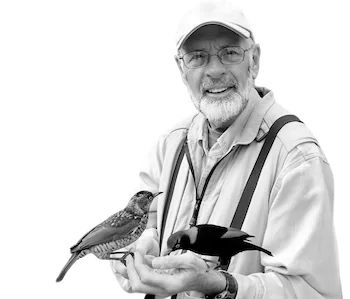
John Kricher is the A. Howard Meneely Professor of Biology at Wheaton College, a Fellow in the American Ornithologists Union, and member of the Science Advisory Committee of the Council of the Massachusetts Audubon Society. He has previously served as president of the Association of Field Ornithologists, the Wilson Ornithological Society, and the Nuttall Ornithological Club, and as a member of the board of directors for the Manomet Center for Conservation Sciences, the New Jersey Audubon Society, and the American Birding Association. Dr. Kricher has conducted Earthwatch-sponsored research on migrant birds on their wintering grounds in Belize, and led numerous trips to places including Cape May, Block Island, coastal New England, Arizona, the Pacific Northwest, Belize, Guatemala, Costa Rica, Peru, Ecuador, Galapagos Islands, Panama, and Trinidad. He has authored over 100 papers and articles in scientific journals as well as magazines and newspapers. Besides The Balance of Nature, Kricher’s books include Galapagos: A Natural History (Smithsonian Institution 2002; paperback Princeton 2006), four titles in the Peterson series, of which A Neotropical Companion has been translated into Spanish through the American Birding Association. John and his wife, Martha Vaughan, divide their time between Pocasset, Massachusetts, on Cape Cod and Sunbury, Georgia.
Pull this thread
There is no balance of nature, not now and not at any point in Earth's history.
Know something the rest of us don't?
Most threads on Rorotoko begin with our invitation. Any thread can begin with a proposal: you write it with the same prompts every thread answers, and we review it.
Propose a thread →