
Gary Y. Okihiro
Pineapple Culture
Places are human geographies of space. They name and attribute natures to spaces, marking them and frequently ranking them as self or other, desirable or undesirable, masculine or feminine. “Home” and “nation” are examples of places, as are “islands” and “continents,” the “tropics” and the “temperate zone.” In our everyday lives, we often assume and forget that places are human inventions, and we treat them as if they were real, which in turn gives them materiality and substance. Places are thereby made real.
The “tropics” was created by some in the temperate zone who named the band and described its lush vegetation, soft and fleshy peoples, and recumbent societies as having been shaped by the moisture and heat. They composed a tropical hermeneutics of place. Climate, the ancient Greeks contended, shaped the bodies and natures of peoples. Accordingly, they maintained, the tropics bred slavish and womanly races while the temperate zones conditioned hard, lean, masculine races. Geographical determinism, which connects places (climates) with races (bodily constitutions) and which ranks them as superior and inferior, remains a key fallacy of our age.
The pineapple’s migrations reveal the falsity of those distinctions of lands and peoples. The fruit, as a trophy and object of empire, appears in its natural state, sized and boxed for the traditionalist and in its clipped, dissected, and sweetened state for the modernist. The fruit reaches both markets and tastes year-round in disregard of seasons and places and advances a global, material culture and signification that qualifies and diminishes the contrived distances between the polarities of West and East, continents and islands, temperate and tropical zones.
Editor: Erind Pajo
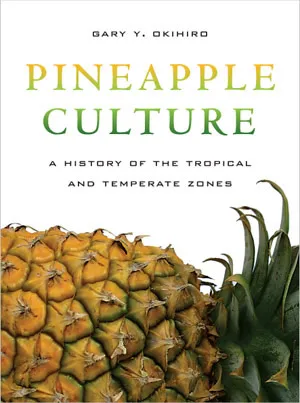
Pineapple Culture
Gary Y. Okihiro Pineapple Culture: A History of the Tropical and Temperate Zones University of California Press 272 pages, 6 x 8 inches ISBN 978 0520255135
Available here →August 12, 2009
20090812-okihiro-gary-pineapple-culture-history-tropical-temperate-zones-2
The wide angle
The rest of this thread

Corky Lee
Gary Y. Okihiro
Gary Y. Okihiro is a historian and professor of international and public affairs at Columbia University. He is the author of ten books, and is currently completing a trilogy on space/time, which besides Pineapple Culture includes Island World: A History of Hawaii and the United States (University of California Press, 2008) and the forthcoming “Disciplining Subjects: Self and History.”
Pull this thread
pulls againstpulls alongside
The tropics are an invention of the temperate zone, and the pineapple's circuit falsifies the ranking they carry.
Against EA · Japanese colonial nostalgia for Korean folk culture turned it into the emblem of nationality for post-liberation Korea. On: The colonial relation is adequately described as domination and erasure of the colonized
Against EG · Ancient Mediterranean peoples built their identities more by claiming kinship with foreigners than by disparaging them. On: Groups constitute their identity chiefly by defining themselves against an excluded Other
Against MO · West Africans controlled the terms of early modern trade on their own coast, including the trade in enslaved people. On: The colonial relation is adequately described as domination and erasure of the colonized
Against MR · A nineteenth-century Istanbul artwork's meaning belongs to the circuit it moved through, not to its maker. On: Groups constitute their identity chiefly by defining themselves against an excluded Other
Alongside BS · African restitution claims began in 1965 and were defeated by European museum directors, so today's debate happened forty years ago. On: The colonial relation is adequately described as domination and erasure of the colonized
Alongside IA · German thinkers from Leibniz to Nietzsche knew far more about their Ottoman neighbours than their published work admits. On: Groups constitute their identity chiefly by defining themselves against an excluded Other
Alongside CF · Environmental concern did not arrive late in France, and environmentalism has no single political valence. On: The colonial relation is adequately described as domination and erasure of the colonized
Alongside DS · Dehumanization works because its victims are seen as human vermin, uncanny fusions of fellow human and subhuman creature. On: Groups constitute their identity chiefly by defining themselves against an excluded Other
Know something the rest of us don't?
Most threads on Rorotoko begin with our invitation. Any thread can begin with a proposal: you write it with the same prompts every thread answers, and we review it.
Propose a thread →