
Rob King
The Fun Factory
The Keystone Film Company is one of those film studios whose name immediately conjures up a host of associations. Founded in 1912 by Irish-Canadian Mack Sennett, Keystone was the studio where many of the legends of silent film comedy first became stars – Mabel Normand, Ford Sterling, Roscoe “Fatty” Arbuckle, Charlie Chaplin, and Ben Turpin, among many others. It was a company that defined a hugely influential style of fast-paced knockabout: the frantic Keystone cops, crazy chases with flivvers and police wagons, and, of course, the Bathing Beauties – all of these made an indelible mark on US culture at the beginning of the twentieth century. Keystone is unquestionably the most important film company in the history of American comedy.
For me, though, the crucial issue is to ask why Keystone was so influential. Why this style of screen comedy, rather than any other? After all, it’s not as though the studio was the only one, or even the first, to put slapstick comedy on screen. There were other comic filmmakers prior to Keystone’s, many of whom were extremely popular (people like Augustus Carney and John Bunny, to say nothing of the French comedian Max Linder). If we really want to understand the nature of Keystone’s contribution, it seems to me, we have to adopt a perspective that looks beyond the studio gates to consider the company’s meaning in the larger cultural landscape of the time.
In its broadest strokes, this is what The Fun Factory tries to do. The book is at once a studio history and an analysis of that studio’s cultural moment.
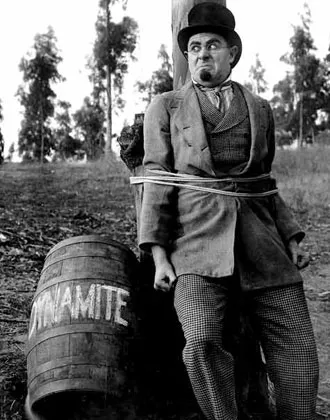
Ford Sterling in Love and Dynamite (1914)
Editor: Erind Pajo
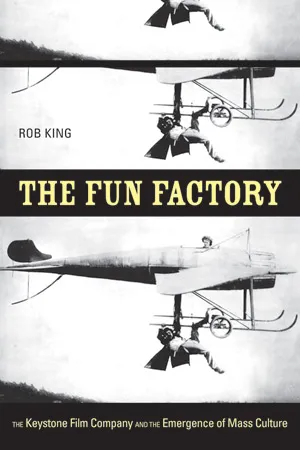
The Fun Factory
Rob King The Fun Factory: The Keystone Film Company and the Emergence of Mass Culture University of California Press 276 pages, 9 x 6 inches ISBN 978 0520255388 ISBN 978 0520255371
Available here →August 14, 2009
20090814-king-rob-fun-factory-keystone-film-company-emergence-mass-culture-1-1
In a nutshell
The rest of this thread

Rob King
Rob King is an assistant professor at the University of Toronto’s Cinema Studies Institute and Department of History, where he is currently working on a study of early sound slapstick and Depression-era mass culture. In addition to The Fun Factory, he is the co-editor of the volumes Early Cinema and the “National” (John Libbey Press, 2008) and, with Tom Paulus, Slapstick Comedy (Routledge, forthcoming 2010).
Pull this thread
Keystone's significance lies in slapstick's passage from working-class culture to the centre of an emergent mass culture.
Know something the rest of us don't?
Most threads on Rorotoko begin with our invitation. Any thread can begin with a proposal: you write it with the same prompts every thread answers, and we review it.
Propose a thread →