
Rob King
The Fun Factory
It can admittedly be difficult to sense this kind of “sociology” of comedy – in large part because of our nostalgic fixation on images of custard pies and Keystone cops. So a brief example might be helpful.
The film Dough and Dynamite provides an interesting test case. First released in November 1914, Dough and Dynamite is one of the few “famous” Keystone comedies – that is, it’s one of the few films that might have been seen by non-specialists. Notably, it was this film that set its star and director, a certain Charles Chaplin, on the course of bone fide film stardom. Even at the time, film critics and writers pointed to this movie as the one that set “everyone talking about the new funny man.”
At face value, the movie is full bore, rough-and-tumble slapstick: Chaplin and his co-star, Chester Conklin, play waiters in a teashop who are put to work in the adjoining bakery when the bakers go on strike. What unfolds is a series of chaotic scenes that, in the words of one noted Chaplin biographer, have seemed little more than “an excuse for ... the fun to be had from sticky dough.” Certainly, there’s a lot of fun to be had: bags of flour, exploding loaves of bread, doughnuts – all contribute to the film’s dough-drenched knockabout.
But is this all that the film is about? Is it adequate to describe the film as simply a comedy about “sticky dough”?As soon as we pay attention to the broader context of working-class life, it becomes clear that the film was in fact profoundly engaged with recent events in the Los Angeles labor movement. The contemporary point of reference for Dough and Dynamite was the hard-fought struggle of the city’s bakers’ unions for better working conditions, widely reported in the Los Angeles labor press. In what had been the most conspicuous labor crusade in southern California in the early teens, the Jewish and general bakers’ unions had joined forces in an ambitious campaign of striking at open shop bakeries.
The bakery setting of Dough and Dynamite was, then, far more than the opportunity for fun with “sticky dough” that a more insulated appropriation of this film would suggest. Rather, it was a point of engagement with current labor issues. But as soon as we realize this, then we have to ask a number of further questions about representations of labor within early cinematic mass culture. Why was it a film about a local bakers’ strike, of all possible subjects, that made Chaplin a star? How did audiences at the time respond to these images of striking workers and by what processes did those images function as comedy?
Now, admittedly, Dough and Dynamite is an exceptional case, and it’s certainly not my argument that Keystone’s early films are always about strikes, unions, and other class issues. Still what Dough and Dynamite does show – and in an unusually literal way – are the ways these movies were involved in the broader plebeian culture of their time. What one finds in these films may not be “representations of workers” in the realist sense characteristic of, say, social problem films. Even so, the films do present an array of comic characters and comic formulas that derived quite directly from the traditions and experiences of working-class life in turn-of-the-century America.
The Fun Factory devotes chapters to many of these – to the glamorous Bathing Beauties and new models of femininity, to ethnic stereotyping and the increased immigration of the period, and to the pace and style of Keystone comedy and the broader context of industrialization, among other areas.
If there’s one thing that I’d hope for this book, it is that it stirs up interest in the early phase of film comedy’s development – that is, in comedies produced prior to the more well-known features of the 1920s.
Of course, silent comedy remains popular to this day; yet its image has long been dominated by the comedians of the late silent era – people like Buster Keaton, Harold Lloyd, Laurel and Hardy. Show an audience an acknowledged classic like Keaton’s The General (1927) and you’re going to get a lot of laughs; show a short comedy from the 1910s and, like as not, it won’t play quite as well.
Early comedy can often seem a quite alien terrain, especially to those encountering it for the first time. And yet, rather than dismiss these films for lacking the polish of their later counterparts – a very unhistorical thing to do – we need to let them pique our curiosity, and let our curiosity guide us toward new discoveries. We need to see that the classic comedies of the 1920s are the culmination of a process; the history of earlier companies such as Keystone show that process in development.
There’s much to be learned, I believe, from studying that process. The parameters of what made people laugh a century ago are obviously quite different from today; but in that very difference lies the possibility for considerable historical exploration and insight.
Fortunately, there now exists an increasing number of venues where these films can be viewed and discussed, studied and debated – annual conventions like Slapsticon in Washington, DC, and the Slapstick festival in the UK, websites like silentcomedians.com and silentcomedymafia.com, as well as media companies putting hard-to-find comedies on commercial DVDs, like Laughsmith and AllDay.
The historical work to be done here remains enormous, of course, but there’s a lot of fun to be had in doing it.
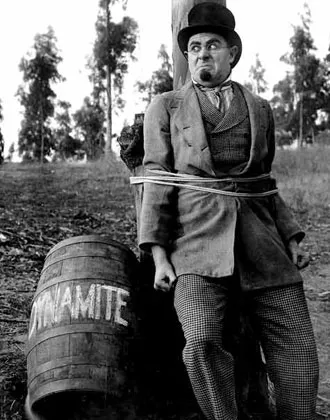
Ford Sterling in Love and Dynamite (1914)
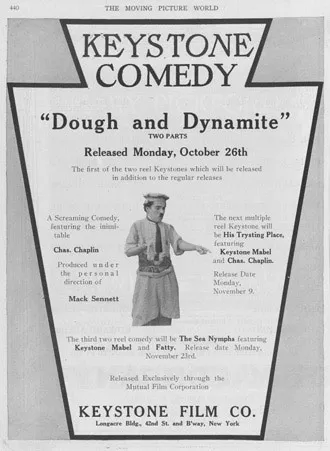
Editor: Erind Pajo

The Fun Factory
Rob King The Fun Factory: The Keystone Film Company and the Emergence of Mass Culture University of California Press 276 pages, 9 x 6 inches ISBN 978 0520255388 ISBN 978 0520255371
Available here →August 14, 2009
20090814-king-rob-fun-factory-keystone-film-company-emergence-mass-culture-3
A close-up
The rest of this thread
Rob King
Rob King is an assistant professor at the University of Toronto’s Cinema Studies Institute and Department of History, where he is currently working on a study of early sound slapstick and Depression-era mass culture. In addition to The Fun Factory, he is the co-editor of the volumes Early Cinema and the “National” (John Libbey Press, 2008) and, with Tom Paulus, Slapstick Comedy (Routledge, forthcoming 2010).
Pull this thread
Keystone's significance lies in slapstick's passage from working-class culture to the centre of an emergent mass culture.
Know something the rest of us don't?
Most threads on Rorotoko begin with our invitation. Any thread can begin with a proposal: you write it with the same prompts every thread answers, and we review it.
Propose a thread →