
Sarah Babb
Behind the Development Banks
The banks’ governing structure mirrors that of private corporations, with voting on their boards weighted by capital contribution. This gives wealthy countries influence out of proportion to their share of the world’s population.
But the reason for the overwhelming American influence in the banks is not so obvious. After all, the U.S. doesn’t have a majority share in any of banks, and it only has a veto on major policy changes in two of them (the World Bank and the Inter-American Development Bank). So why does it carry such weight?
While there are a number of additional reasons, I argue that the most important one—also the most ironic—is that the U.S. does not support the banks wholeheartedly. American policy toward the banks is made by both the executive and Congress—and Congress is almost predictably skeptical.
As a result, when wealthy governments sit down to replenish the banks’ resources, the U.S. negotiator can argue that Congress won’t appropriate the money unless American policy preferences are followed. As the perennial “squeaky wheel,” the U.S. has been very successful in shaping the banks over the past quarter-century.
As a consequence, events in the world of American politics—such as elections, social movements, and the rise of political ideologies—have had a major impact on things multilateral development banks say and do. It is no coincidence that the World Bank became a major promoter of market-liberalizing reforms during the Reagan administration; nor is it a coincidence that the World Bank became more “green” at a time when environmental NGOs had been successfully lobbying key members of Congress.
Editor: Erind Pajo
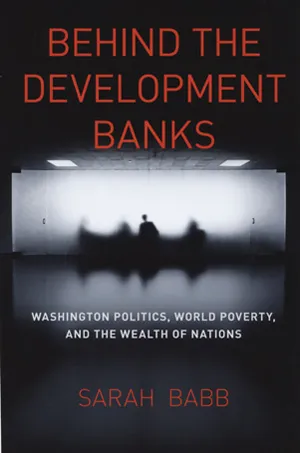
Behind the Development Banks
Sarah Babb Behind the Development Banks: Washington Politics, World Poverty, and the Wealth of Nations University of Chicago Press 336 pages, 9 x 6 inches ISBN 978 0226033648 ISBN 978 0226033655
Available here →August 17, 2009
20090817-babb-sarah-behind-development-banks-washington-world-poverty-2
The wide angle
The rest of this thread
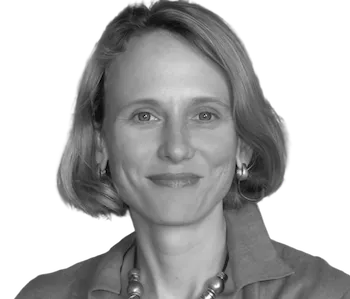
Sarah Babb
Sarah Babb is associate professor of sociology at Boston College. She became interested in international financial institutions as a graduate student living in Mexico in the early 1990s. She is the author of Managing Mexico: Economists from Nationalism to Neoliberalism (Princeton University Press 2001), and has authored and co-authored a number of articles about the relationship between ideas, politics, and economic policy.
Pull this thread
American control of the development banks comes from America's lack of wholehearted support for them, not its shareholding.
Know something the rest of us don't?
Most threads on Rorotoko begin with our invitation. Any thread can begin with a proposal: you write it with the same prompts every thread answers, and we review it.
Propose a thread →