
Sarah Babb
Behind the Development Banks
This book is about how American politics affects the multilateral development banks—or “the banks,” for short. The best known of these is the World Bank, but several regional banks that are smaller play the same role.
The banks are very influential. Their loans and grants give governments around the world incentives to do certain kinds of things and not do other kinds of things. For example, when lots of loans are available for building dams, it is easier for developing-country governments to build dams. The banks also give loans for policy reforms. The most famous example is the World Bank’s “structural adjustment” program that started promoting free-market policies in the 1980s.
The banks also have a big intellectual influence. The World Bank’s publications set the tone for debates in the world of development experts. If you are a development economist, you may disagree with the World Bank’s position on a particular issue, but you can’t ignore it.
In addition to being influential, the banks are controversial. One of the most common criticisms is that they give bad advice. Some people say the World Bank is partly to blame for some major policy failures of the 1980s and 1990s, when many developing county governments deregulated their economies with the help of structural adjustment loans. Another common criticism is that the banks are ineffective, and try to accomplish too many things at once.
Most of these critiques are aimed the banks themselves, blaming either their management or the many economists who advise them. In contrast, I think that we should start looking more at the role of the “shareholder” governments that own the banks. My book argues that since the 1980s, the United States government has been an “activist” shareholder, and has a played a huge role in the banks’ activities and ideas.
Editor: Erind Pajo
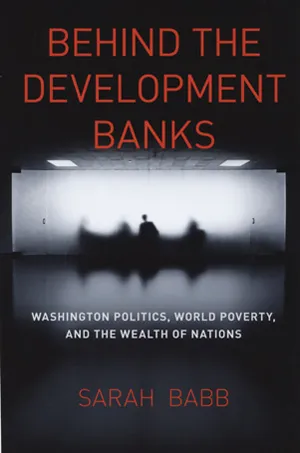
Behind the Development Banks
Sarah Babb Behind the Development Banks: Washington Politics, World Poverty, and the Wealth of Nations University of Chicago Press 336 pages, 9 x 6 inches ISBN 978 0226033648 ISBN 978 0226033655
Available here →August 17, 2009
20090817-babb-sarah-behind-development-banks-washington-world-poverty-1-1
In a nutshell
The rest of this thread

Sarah Babb
Sarah Babb is associate professor of sociology at Boston College. She became interested in international financial institutions as a graduate student living in Mexico in the early 1990s. She is the author of Managing Mexico: Economists from Nationalism to Neoliberalism (Princeton University Press 2001), and has authored and co-authored a number of articles about the relationship between ideas, politics, and economic policy.
Pull this thread
pulls againstpulls alongside
American control of the development banks comes from America's lack of wholehearted support for them, not its shareholding.
Against KS · Countries that prosecute human rights abusers subsequently show better human rights records, so prosecutions deter rather than destabilize. On: International legal institutions change how states behave
Against DB · A norm's legal bindingness does not depend on the bindingness of the consequences for violating it. On: International legal institutions change how states behave
Against RK · European integration is turning Europe's informal, insider style of regulation into a European version of American adversarial legalism. On: International legal institutions change how states behave
Alongside TN · Preventive war is now a general international norm, produced by the humanitarian interventions of the 1990s. On: International legal institutions change how states behave
Alongside EP · States punish violators of international law badly, so they violate it with impunity when benefits exceed costs. On: International legal institutions change how states behave
Alongside PC · National governments are now too small to supply the public goods that make things work, and nothing has taken over. On: International legal institutions change how states behave
Know something the rest of us don't?
Most threads on Rorotoko begin with our invitation. Any thread can begin with a proposal: you write it with the same prompts every thread answers, and we review it.
Propose a thread →