
Charlie Hailey
Camps
When I last flipped through Camps, I paused at three moments that give a sense of the range of possibilities, realities, and complexities in the book. Each stopping point includes an illustration that samples the book’s imagery base and that renders “camp space” – one vertical, one horizontal, and the last a shell within a shell not unlike a Russian doll of space, politics, and mobility.
The first, on page 92, is a tree camp. We are looking up through a conifer stand at the undersides of nineteen “tree boats” suspended, and thus truly floating, in a French arboretum’s stately canopy. It’s a children’s camp turned vertical – a site for dreaming and perhaps for redefining self and community. This aerial cluster always reminds me of Italo Calvino’s baron of the trees who silently and symbolically left the dinner table to ascend the canopy permanently and to form an independent state of reflection and play.
I then turned to page 327 with its birds-eye view of the Benaco camp for refugees in Tanzania. The hazy matrix of tents and shelters extends to the horizon.
The Rwandan genocide of 1994 displaced millions, with sites such as Benaco regularly exceeding a quarter-million inhabitants. In this section of the book, I discuss camps that fall between conditions of autonomy and control. For many, Benaco, as well as camps west of Rwanda in Zaire, made visible the scale of such emergencies. It was also an important moment in the process of understanding how interactions of camp, crisis, and need continued to alter forms of assistance and aid agencies.
“Refugee camp” is widely used, but its descriptive breadth hides more particular iterations of dislocation – self-settlement, economic migration, and internal displacement. Kofi Annan called this latter condition – effecting millions of internally displaced persons who reside in “IDP Camps” – the “great tragedy of our time.” These camps are some of the most densely populated places on earth, but the sites are horizontally and marginally distributed where comparable densities are typically vertical and urban, and they are considered temporary when they are essentially semi-permanent. With Benaco camp as a starting point, this section of the book investigates how camps of necessity are planned, protected, named, reported, and inhabited.
On page 424, a photograph, in the news again this summer, triggered my last stopping point. Forty years ago President Nixon greeted the Apollo 11 crew through the sealed rear window of an Airstream trailer serving as a mobile quarantine vehicle.
In the next photograph on page 427, the narrative is less visible, but evocatively recognizable nonetheless. In this case, we are looking inside the fuselage of a C-17 military cargo jet between its external hull and the shining metallic shell of an Airstream. Its recreational line once referred to as the “Silver Palace,” this trailer now seals distinguished military personnel from distractions and danger in a military construct known as the “Silver Bullet.” This last example, which I summarize as “In-flight Camp,” demonstrates how camping vehicles and camp spaces sometimes collide and in the process blur distinctions of autonomy and control.
In the past few months, news and media outlets have reported on homeless camps, at times linking the resurgence of these sites to economic crisis. Last February, the Oprah Winfrey show sent correspondents to Sacramento’s tent cities, which had become global symbols of the recession.
In late March, tent cities came up in President Obama’s press conference when a reporter cited a statistic that 1 in 50 children are homeless in the United States.
In some reports, I have sensed a tone of surprise at the degree of self-organization found in many of the tent cities and homeless camps. But instances like the village concept camps in the Pacific Northwest return to essentials of community and demonstrate possible transitional sites – what architect Mark Lakeman has called “dynamic self-help environments.” These spaces are “provisional” in the rooted sense of the word, offering necessary provisions, prospectively looking to the near future, and offering a platform (however transitory) for dignity and humanity.
One main goal of Camps is to provide a preliminary context for critical discussion and for rethinking contemporary issues. I hope to have opened up possibilities for a discipline of “camp studies” – in which camps are not simply vehicles of escape, means to ends, or hasty solutions to problems, but are modes of interrogation themselves. Put another way, camps should not be viewed passively as mere symptoms of the times – Agamben has warned of exceptions becoming the rule – but should be read actively as beacons, warnings, registers, and signals of problem and possibility. Small settlements can rapidly expand in scale and population, the open can just as easily become closed, and eccentric locations afforded by camp’s flexibility offer escape but also result in marginalization and invisibility. Such a discipline must persistently ask “what is a camp?”
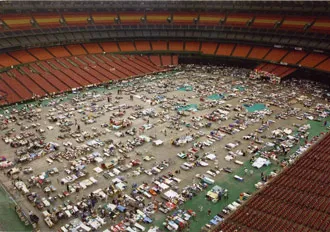
Interior view of Reliant Astrodome, Houston, Texas, September 2005 (Andrea Booher / FEMA).
Editor: Erind Pajo
Camps
Charlie Hailey Camps: A Guide to 21st-Century Space MIT Press 536 pages, 53/8 x 8 inches ISBN 978 0262512879
Available here →September 4, 2009
20090902-hailey-charlie-camps-guide-21st-century-space-3
A close-up
The rest of this thread
Charlie Hailey
Charlie Hailey is Professor of Architecture in the University of Florida’s School of Architecture. A registered architect, Hailey has received numerous awards and grants, including a Guggenheim Fellowship and a Graham Foundation grant. He is the author of Design/Build with Jersey Devil (Princeton Architectural Press, 2016), Spoil Island: Reading the Makeshift Archipelago (Rowman& Littlefield, 2013), Camps: A Guide to 21st-Century Space (MIT Press, 2009), also featured on Rorotoko, and Campsite: Architectures of Duration and Place (LSU Press, 2008). His most recent book Slab City: Dispatches from the Last Free Place (MIT Press) with photographer Donovan Wylie was published in October 2018.
Pull this thread
Camps are instruments of inquiry, the first places where local and global forces register.
Know something the rest of us don't?
Most threads on Rorotoko begin with our invitation. Any thread can begin with a proposal: you write it with the same prompts every thread answers, and we review it.
Propose a thread →