
Charlie Hailey
Slab City
When you pick up Slab City, you might open it to Donovan’s photograph of an A-frame shelter made of pallets and cardboard. Late one afternoon in June, its builder gave us a tour of its three levels that included a lounge, two bedrooms, a workshop where he hacked the proprietary systems of rechargeable power tools, and a loft where you could see the Algodones Dunes and the U.S. Mexico border beyond. To the east, we saw plumes of smoke from exploded ordnance in the still-active military range just across the canal. For us, this structure held the personal aspirations of its builder as it also reflected the core of Slab City as a collective laboratory to test freedom in its many built forms.
The A-frame also indexes the resourcefulness and resilience in its materials—the pallets came from the local Target in El Centro but had previously crossed borders and supported goods along the 21st century’s global supply lines, and the cardboard had packaged a recent delivery of photovoltaic panels for one of the massive solar farms nearby. To deflect the harsh desert sun, the cardboard was coated with white paint that came from Salvation Mountain.
In Donovan’s photograph, the flags above the A-frame have slackened in the dry heat of afternoon, and it is as if the builder has taken a break from painting and stepped back to admire his work. When I returned last year, this structure was gone. Across the road, a new pallet shelter had been built with a steeper A-frame, inclined like hands clasped in a kind of prayer.
Slab City is a field guide to a remote, transitory place. A folded map in the back pocket shows the layout and inventory of the military camp’s 1946 facilities. We carried that map each day we walked among the slabs. It helps locate the sixty-five slabs that have remained after the camp was decommissioned and its structures were removed. Like the slabs, the map is also a substrate for coming to terms with this place, for understanding how Slab City’s residents endure the difficulties of desert life and the frequent challenges to its public status. To pour concrete on sand is to test permanence in a mutable place. To live in Slab City is to experiment with the idea of freedom in a vestige of frontier space. And to write about and to photograph Slab City’s structures is to narrate an ongoing struggle between autonomy, necessity and control.
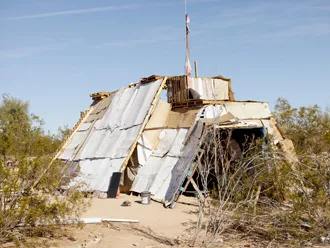
Shelter in Slab City Photo by Donovan Wylie.
Editor: Judi Pajo

Slab City
Charlie Hailey and Donovan Wylie Slab City: Dispatches from the Last Free Place MIT Press 192 pages, 7 x 9 inches ISBN 9780262038355
Available here →July 12, 2019
20190710-hailey-charlie-on-book-slab-city-dispatches-last-free-place-3-1
A close-up
The rest of this thread

Charlie Hailey
Charlie Hailey is Professor of Architecture in the University of Florida’s School of Architecture. A registered architect, Hailey has received numerous awards and grants, including a Guggenheim Fellowship and a Graham Foundation grant. He is the author of Design/Build with Jersey Devil (Princeton Architectural Press, 2016), Spoil Island: Reading the Makeshift Archipelago (Rowman& Littlefield, 2013), Camps: A Guide to 21st-Century Space (MIT Press, 2009), also featured on Rorotoko, and Campsite: Architectures of Duration and Place (LSU Press, 2008). His most recent book Slab City: Dispatches from the Last Free Place (MIT Press) with photographer Donovan Wylie was published in October 2018.
Pull this thread
Freedom at Slab City is built rather than found, since residents' structures hold their sites while they are away.
Know something the rest of us don't?
Most threads on Rorotoko begin with our invitation. Any thread can begin with a proposal: you write it with the same prompts every thread answers, and we review it.
Propose a thread →