
Charlie Hailey
Slab City
A starting premise for our work was that camps, like Slab City, accommodate conditions that might otherwise remain without space. Camps are also bellwethers—early indicators of change and registers of the challenges faced by those who camp, whether by choice or out of necessity. It is true that Slab City, as the “last free place,” is a camp of autonomy where slabbers can experiment with ways of living and building. There are very few places where you have the independence to build and tear down at will. But its residents also contend with the weight of that freedom, the transience that goes along with it, and the depth of a history that extends well beyond the slabs. Studying Slab City, we found evidence of broader narratives that have defined a country and its identities—legacies that continue to be debated.
The depth of Slab City’s multivalent histories and contemporary practices reexamine frontier and land tenure, resources and resourcefulness, Manifest Destiny and “city on a hill,” and migrancy and a country’s internally displaced people.
Slab City is built on layers of past settlements. The residue of the military camp is there, and some residents curate its memory as a form of patriotism. Immediately adjacent to Slab City, an active bombing range is also a constant reminder of that recent past. Much earlier, this site hosted the camps of Cahuilla Indians who harvested clams and fish along the shore of the natural lake (sometimes connected to the Gulf of California) that later became the accidentally created Salton Sea, when human efforts to control the Colorado River catastrophically failed. On your way to Slab City, you uncannily emerge from below “sea level” (there’s a small sign along the road) to reach East Mesa, where slabbers now occupy the ancient coastline amid sand, concrete slabs, and shell middens. Soon after the military camp was decommissioned, its slabs hosted migrant farm workers harvesting creosote.
Donovan and I are both interested in the architectures of resistance and adaptation.
Slab City is an effort to synthesize Donovan’s ground-breaking studies of the architecture of control with my interest in emergent built environments that must contend with transience. Questions we have asked here and in our continued collaboration are: What are the architectural consequences when freedom and control overlap? What happens when freedom from intersects with freedom of? How might public land host private aspirations? How to make home in an unhomely place? What are the material consequences when desire and need come together in a self-governed place? How do makeshift dreams ride the desert sea like concrete slabs on sand?
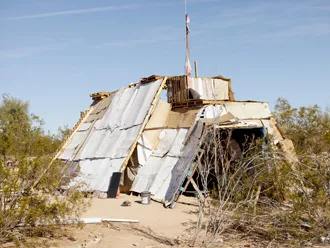
Shelter in Slab City Photo by Donovan Wylie.
Editor: Judi Pajo

Slab City
Charlie Hailey and Donovan Wylie Slab City: Dispatches from the Last Free Place MIT Press 192 pages, 7 x 9 inches ISBN 9780262038355
Available here →July 11, 2019
20190710-hailey-charlie-on-book-slab-city-dispatches-last-free-place-2-1
The wide angle
The rest of this thread
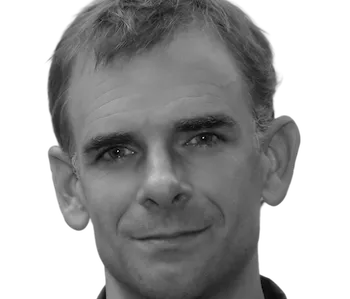
Charlie Hailey
Charlie Hailey is Professor of Architecture in the University of Florida’s School of Architecture. A registered architect, Hailey has received numerous awards and grants, including a Guggenheim Fellowship and a Graham Foundation grant. He is the author of Design/Build with Jersey Devil (Princeton Architectural Press, 2016), Spoil Island: Reading the Makeshift Archipelago (Rowman& Littlefield, 2013), Camps: A Guide to 21st-Century Space (MIT Press, 2009), also featured on Rorotoko, and Campsite: Architectures of Duration and Place (LSU Press, 2008). His most recent book Slab City: Dispatches from the Last Free Place (MIT Press) with photographer Donovan Wylie was published in October 2018.
Pull this thread
Freedom at Slab City is built, not found.
Know something the rest of us don't?
Most threads on Rorotoko begin with our invitation. Any thread can begin with a proposal: you write it with the same prompts every thread answers, and we review it.
Propose a thread →