
Mike Hulme
Why We Disagree About Climate Change
The idea of climate change carries quite different meanings. It is used to support different political, social and technological projects and seems to imply different courses of action.
The Intergovernmental Panel on Climate Change (IPCC) has constructed a powerful scientific consensus about the physical transformation of the world's climate. This is a reality that I believe in. But there is no comparable consensus about what the idea of climate change actually means to people or to human societies.
Four contemporary and contrasting ways of narrating the significance of climate change illustrate just some of the more salient discourses currently in circulation:
- Climate change as a battleground between different philosophies and practices of science, between different ways of knowing.
- Climate change as justification for the commodification of the atmosphere and, especially, for the commodification of the gas carbon dioxide.
- Climate change as the inspiration for a global network of new, or re-invigorated, social movements.
- Climate change as a threat to ethnic, national and global security.
All of the above suggests that far from starting with ignorance and ending with certainty, the story of climate change is a much more interesting one to tell. The full story of climate change is the unfolding story of an idea and how this idea is changing the way we think, feel and act. Not only is climate change altering our physical world, but the idea of climate change is altering our social worlds. And this idea is reaching farther and farther across these social worlds.
Rather than asking ‘How do we solve climate change?’ we need to turn the question around and ask ‘How does the idea of climate change alter the way we arrive at and achieve our personal aspirations and our collective social goals?’ By understanding why we disagree about climate change we will also understand better what it takes to live sustainably on a crowded finite planet inhabited by a quarrelsome species.
The account of climate change that I present in the book emerges from my own encounter with climate change over the last thirty years. This encounter started while I was a university student, continued during my time as a post-doctoral researcher and, more recently, has persisted through my roles as a professor, research leader, educator and public speaker. These personal and professional experiences have shaped the way I now view climate change. This journey is also worth noting because the period through which I have travelled—from the late 1970s to today—coincides with the transformation of climate change from an object of largely scientific professional interest into a topic of daily and worldwide popular discourse.
I should also state clearly my own position with regard to climate change in case I am misunderstood. I believe that the risks posed to people and places by the physical attributes of climate are tangible, and serious, and they need constantly improving forms of human intervention and management. I believe that the physical functions of global climate and, consequently, the parameters of local weather are changing (largely) under the influence of the changing composition of the atmosphere caused by an array of human activities. And I believe that changes in climatic risks induced by such global climate change are also important and serious. We do well to minimise these risks by reducing the vulnerability of those exposed to them and by minimising further changes to the composition of the world’s atmosphere.
Yet I do not believe that the way we have framed these goals—most significantly through the UN Framework Convention on Climate Change and the Kyoto Protocol—is the only way of doing so. Nor do I believe it is necessarily the most appropriate way. I feel uncomfortable that climate change is widely reported through the language of catastrophe and imminent peril, as ‘the greatest problem facing humanity’ that demands to trump all others. I believe that such reporting both detracts from what science is good at revealing to us and diminishes the many other ways of thinking, feeling and knowing about climate which are also essential elements in personal and collective decision-making.
Why We Disagree About Climate Change is my attempt to articulate the reasons for these beliefs and to re-situate the idea of climate change more honestly as the subject of a more creative and less pejorative discourse.
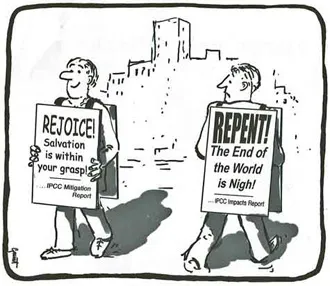
A characterisation of contrasting key messages in the IPCC Fourth Assessment Report, 2007. (Tiempo; © Lawrence Moore)
Editor: Erind Pajo

Why We Disagree About Climate Change
Mike Hulme Why We Disagree About Climate Change: Understanding Controversy, Inaction and Opportunity Cambridge University Press 432 pages, 9 x 6 inches ISBN 978 0521727327
Available here →October 9, 2009
20091009-hulme-mike-disagree-climate-change-controvers-inaction-opportunity-2
The wide angle
The rest of this thread

Mike Hulme
Mike Hulme is Professor of Climate Change in the School of Environmental Sciences at the University of East Anglia (UEA) and was the Founding Director of the Tyndall Centre for Climate Change Research from 2000 to 2007. He is editor-in-chief of the newly commissioned Wiley’s Interdisciplinary Reviews: Climate Change. His books include Climates of the British Isles (1997), Why We Disagree About Climate Change (2009), and the forthcoming edited volume Making Climate Change Work For Us. He was a convening lead author for the IPCC Third Assessment Report.
Pull this thread
Climate change is not a problem that can be solved, and treating it as one guarantees failure.
Know something the rest of us don't?
Most threads on Rorotoko begin with our invitation. Any thread can begin with a proposal: you write it with the same prompts every thread answers, and we review it.
Propose a thread →