
Mike Hulme
Why We Disagree About Climate Change
Towards the end of the book I put forward four myths about climate change. I would hope people may recognise the truths about our relationship with climate change that each of these myths embodies. Each captures different aspects of ways in which humans see themselves, relate to each other and seek to live on the Earth.
We talk about climate change using the language of lament and nostalgia, revealing our desire to return to some simpler more innocent era. We are uneasy with the unsought powers to change global climate we now have. This is the myth of Eden.
We talk about climate change using the language of fear and apocalypse, revealing our endemic worry about the future. But we have lost the sense of transcendent mystery and gratitude that once offered us conduits for defusing these fears. This is the myth of Apocalypse.
We talk about climate change using the language of pride and control, revealing our desire for dominance and mastery. Climate change now offers us a global domain for such mastery, but we lack the wisdom and humility to exercise it. This is the myth of Prometheus.
And we talk about climate change using the language of justice and equity, revealing the inescapable call for humans to redress revealed injustices. This is the Themisian myth. But climate change also reveals the limits of our individual moral agency.
The value in offering these mythical stories that underpin our discourses about climate change is that they allow people to explore issues now hidden because not seen. If we continue to talk about climate change as an environmental problem to be solved, if we continue to understand the climate system as something to be mastered and controlled, then we have missed the main lessons of climate change. If climate means to us only the measureable and physical dimensions of our life on Earth then we will always be at war with climate. Our climates will forever be offering us something different to what we want.
I argue that climate change is not a problem that can be solved in the sense that, for example, technical and political resources were mobilised to ‘solve’ the problem of stratospheric ozone depletion or asbestos in our buildings. We need to approach the idea of climate change from a different vantage point. We need to reveal the creative psychological, spiritual and ethical work that climate change can do and is doing for us.
By understanding the ways climate change connects with foundational human instincts of nostalgia, fear, pride and justice we open up a way of re-situating culture and the human spirit at the centre of our understanding of climate. Human beings are more than merely material objects and climate is more than merely a physical category. Rather than catalysing disagreements about how, when and where to tackle climate change, we must approach the idea of climate change as an imaginative resource around which our collective and personal identities and projects can and should take shape.
In the concluding chapter I look beyond the mere physicality of climate change as an environmental problem to be solved. I argue that because climate change is a ‘wicked problem’ it does not lend itself to a solution—whether to elegant solutions or even clumsy ones.
If we pursue the route of seeking ever larger and grander solutions to climate change we will continue to end up frustrated and disillusioned: global deals will be stymied, science and economics will remain battlegrounds for rearguard actions, global emissions will continue to rise, vulnerabilities to climate risks will remain. And we will end up unleashing ever more reactionary and dangerous interventions in our despairing search for a solution to our wicked problem: the colonisation of agricultural land with energy crops, the colonisation of space with mirrors, the colonisation of the human spirit with authoritarian government. Rather than placing ourselves in a ‘fight against climate change’ we need a more constructive and imaginative engagement with the idea of climate change. Solving climate change should not be the focus of our efforts any more than we should be ‘solving’ the idea of human rights or liberal democracy. It really is not about stopping climate chaos. Instead, we need to see how we can use the idea of climate change—the matrix of ecological functions, power relationships, cultural discourses and material flows that climate change reveals—to re-think how we take forward our political, social, economic and personal projects over the decades to come. As a resource of the imagination, the idea of climate change can be deployed around our geographical, social and virtual worlds in creative ways. The idea of climate change can stimulate new thinking about technology. It can inspire new artistic creations in visual, written and dramatised media. It can invigorate efforts to protect our citizens from the hazards of climate. The idea of climate change can provoke new ethical and theological thinking about our relationship with the future. It can arouse new interest in how science and culture inter-relate. It can galvanize new social movements to explore new ways of living in urban and rural settings. And the idea of climate change can touch each one of us as we reflect on the goals and values that matter to us.
These are all creative applications of the idea of climate change, but they are applications that do not demand global agreement. Indeed, they may be hindered by the search for agreement. I argue that they thrive in conditions of pluralism and hope rather than in conditions of universalism and fear. And nor are they applications that will lead to stabilising global climate—they will not ‘solve’ climate change.
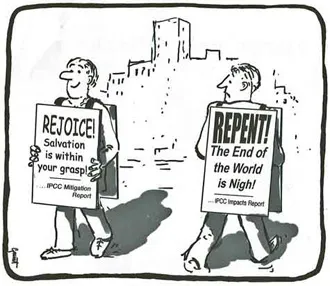
A characterisation of contrasting key messages in the IPCC Fourth Assessment Report, 2007. (Tiempo; © Lawrence Moore)
Editor: Erind Pajo

Why We Disagree About Climate Change
Mike Hulme Why We Disagree About Climate Change: Understanding Controversy, Inaction and Opportunity Cambridge University Press 432 pages, 9 x 6 inches ISBN 978 0521727327
Available here →October 9, 2009
20091009-hulme-mike-disagree-climate-change-controvers-inaction-opportunity-3
A close-up
The rest of this thread

Mike Hulme
Mike Hulme is Professor of Climate Change in the School of Environmental Sciences at the University of East Anglia (UEA) and was the Founding Director of the Tyndall Centre for Climate Change Research from 2000 to 2007. He is editor-in-chief of the newly commissioned Wiley’s Interdisciplinary Reviews: Climate Change. His books include Climates of the British Isles (1997), Why We Disagree About Climate Change (2009), and the forthcoming edited volume Making Climate Change Work For Us. He was a convening lead author for the IPCC Third Assessment Report.
Pull this thread
Climate change is not a problem that can be solved.
Know something the rest of us don't?
Most threads on Rorotoko begin with our invitation. Any thread can begin with a proposal: you write it with the same prompts every thread answers, and we review it.
Propose a thread →