
Lawrence B. Glickman
Buying Power
Long distance solidarity is perhaps the key concept I explore in this book. Consumer activists were among the first Americans to declare that moral agency should not be dictated by geography. They did so not for abstract reasons (about human brotherhood, for example) or because they necessarily held that every person on earth was equally worthy. The claim for the importance of long distance solidarity was far more concrete. Consumer activists argued that consumers’ actions had a direct impact on the people who made and sold the goods they bought. Consumers in the aggregate held tremendous power over these people and thus had a concomitant responsibility to exercise this power in an ethical fashion.
In making this claim about consumer power and responsibility, consumer activists consistently challenged contemporary standards of moral responsibility: not, as did most critics, because those standards set the bar too high, but because they set it too low.
Humanitarianism in the late-eighteenth and nineteenth centuries and philanthropy in the twentieth and twenty-first have urged individuals to feel sympathy for, and to alleviate the suffering of, others, typically through charitable donations. But they have not held the individuals whose donations and support they seek responsible for that suffering. By contrast, consumer activists, from the late eighteenth century onward, posited a networked world (hence their favored metaphors of the web and the chain), in which there existed no guilt-free observers. If humanitarians and philanthropists urged Good Samaritans to step in after the suffering for which they bore no responsibility, consumer activists held shoppers liable for the suffering.
Consumer choices, in their view, were inevitably moral choices as well. Consumer activists proclaimed the “death of moral distance,” long before recent debates about the need to “think globally.” No matter how far away physically, victims of deleterious consuming practices were not unrelated to consumers in a moral sense. Consumer activists, in effect, proposed a new physics of time and space, highlighting the real-time effects of consumption and suggesting that in an increasingly networked economy, the moral impact of one’s actions was not determined by physical propinquity but by the market-based effects of one’s economic actions.
Beginning in the late eighteenth century, the logic of consumer activism held that consumption might and probably did influence the morality of one’s relationships with the distant and unknown workers who produced the goods one bought—as well as with their employers, environment, and countries.
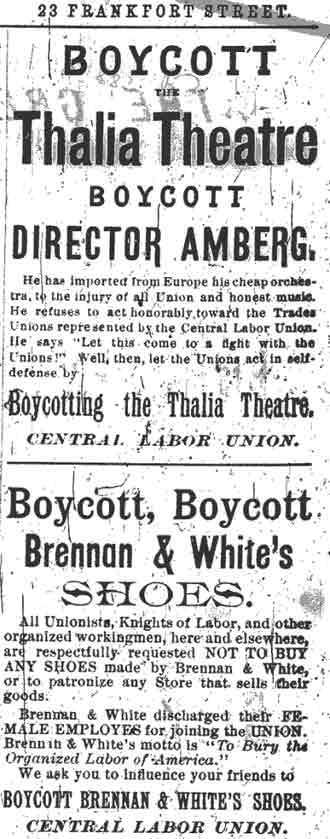
From page 117: Announcements of boycotts in a newspaper created by boycotting printers. (New York Boycotter, Nov 14, 1885, 3.)
Editor: Erind Pajo
Buying Power
Lawrence Glickman Buying Power: A History of Consumer Activism in America University of Chicago Press 424 pages, 6 x 9 inches ISBN 978 0226298658
Available here →October 26, 2009
20091026-glickman-lawrence-on-buying-power-history-consumer-activism-2
The wide angle
The rest of this thread

Lawrence B. Glickman
Lawrence B. Glickman is professor of history at the University of South Carolina, where he has taught since 1992. His other books include, A Living Wage: Americans Workers and the Making of Consumer Society (1997); Consumer Society in American History: A Reader (1999); and, co-edited with James W. Cook and Michael O’Malley, The Cultural Turn in U.S. History: Past, Present, and Future (2008). He has received fellowships from the National Endowment for the Humanities, the American Philosophical Society, and Princeton University’s Center for Human Values. He has published in the Journal of American History, the American Quarterly, the Journal of Social History, the Boston Globe, the New York Times, the Washington Post, The Nation, and the Huffington Post.
Pull this thread
Consumer activism is one continuous American political tradition from the 1760s on, and it is not a progressive one.
Know something the rest of us don't?
Most threads on Rorotoko begin with our invitation. Any thread can begin with a proposal: you write it with the same prompts every thread answers, and we review it.
Propose a thread →