
Harold James
The Creation and Destruction of Value
The Creation and Destruction of Value focuses on parallels and differences between the current financial crisis and the Great Depression, and asks whether today’s crisis—like that of the Great Depression—might lead to a reversal of globalization, or a significant change in globalization. The Great Depression not only produced a renationalization of politics and economics, but it also led to profound changes in the global geo-political balance.
Almost every contemporary use of the depression analogy takes the year 1929 as a reference point. But there are really two completely different pathologies during the Great Depression, which involve different diagnoses and different cures: they can be labeled in shorthand as 1929 (the Wall Street crash and the beginning of a bad downturn in the U.S.) and 1931 (a banking and financial crisis in Central Europe and South America, which through contagion spread to the U.S. and tuned a bad downturn into the Great Depression).
1929 has been popular with academic and political commentators since it provides a clear motive for taking particular policy measures. Keynesians have been able to demonstrate that government fiscal demand can stabilize the expectations of the market, and thus provide an overall framework of stability. Monetarists have an alternative but rather parallel story of how stable monetary growth means that radical perturbations are avoided.
But there are no obvious macro-economic answers to financial distress of the 1931 kind. As a consequence, the effects of this type of crisis are much longer-lived. The answers, if they exist, lie in the slow and painful cleaning up of balance sheets; and in micro-economic restructuring, which cannot be simply imposed from above by an all-wise planner but requires many businesses and individuals to change their outlook and behavior. The improvement of regulation and supervision, while a good idea, is better suited to avoiding future crises than dealing with the consequences of a catastrophe that has already occurred.
Editor: Erind Pajo
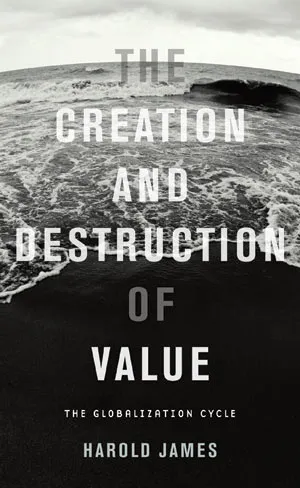
The Creation and Destruction of Value
Harold James The Creation and Destruction of Value: The Globalization Cycle Harvard University Press 252 pages, 4 3/8 x 7 1/8 inches ISBN 978 0674035843
Available here →November 9, 2009
20091109-james-harold-on-creation-destruction-value-globalization-cycle-1-1
In a nutshell
The rest of this thread

Marie Louise James
Harold James
Harold James holds a joint appointment as Professor of History and International Affairs at the Woodrow Wilson School, Princeton University, and as Marie Curie Visiting Professor at the European University Institute. He was educated at Cambridge University (Ph.D. in 1982) and was a Fellow of Peterhouse for eight years before coming to Princeton University in 1986. His books include a study of the interwar depression in Germany, The German Slump (1986); and International Monetary Cooperation Since Bretton Woods (1996). He was also coauthor of a history of Deutsche Bank (1995), which won the Financial Times Global Business Book Award in 1996. More recent works include The End of Globalization: Lessons from the Great Depression (2001). In 2004 he was awarded the Helmut Schmidt Prize for Economic History, and in 2005 the Ludwig Erhard Prize for writing about economics.
Pull this thread
The present crisis is 1931, a banking crisis spreading by contagion, for which no macroeconomic answer exists.
Know something the rest of us don't?
Most threads on Rorotoko begin with our invitation. Any thread can begin with a proposal: you write it with the same prompts every thread answers, and we review it.
Propose a thread →