
Harold James
The Creation and Destruction of Value
One of the most dramatic bubbles of the 2000s occurred in the art market, above all in contemporary art. For fine art overall, the most widely quoted index, the Mei Moses index, showed an annual rise of around 20 percent over a five year period. Art suddenly appeared to be an excellent investment, and art fairs and auctions proliferated.
This particular bubble demonstrates very clearly the link between monetary values and other values. Art became important at the same time as a speculative asset, and as a statement about taste. The capacity of art possessions to make a statement about the owner’s capacity for discernment was at the heart of the appeal of art as an investment category.
In the middle of the financial meltdown of September 2008, a cultural event occurred in London. While the City of London was shaken by the collapse of Lehman Brothers and the run on HBOS, Sotheby’s staged a record-breaking auction for the works of the artist Damien Hirst, which produced a gross take of around $200 million. Compared to the values that were being destroyed on Wall Street, this was small change; but it was a remarkable vote of confidence in the work of one artist. He was increasingly over-extending himself as a result of the appetite of the market. Indeed, a few days after the September sale, Hirst stated that “I don’t have enough time at the moment. I don’t even do my own paintings.
”Why did so many buyers want to acquire the works of Hirst at such extreme prices, and why was the extremity of the reputational bubble such an additional source of attraction? Financial bubbles, like the one that was just definitively bursting at the time of the Hirst auction, are intimately related to the world of art. Renaissance Florence depended on the patronage of the Medici. Sixteenth-century Venice turned the wealth of the spice trade into the canvases of Titian and Tintoretto. The world’s next great commercial center was Amsterdam, where again the successful burghers pushed for a new style of art and produced the age of Rembrandt. The great nineteenth- and early twentieth-century financiers, men like J.P. Morgan, Henry Frick, and Andrew Mellon, spent a large part of their fortunes on art.
Financial judgment, by contrast, is not by its nature open to inspection. It depends on inside deals, on moving ahead of the market. It is impossible to tell who is making good bets and who is gambling recklessly. It is unwise to rely solely on the charm or persuasive capacity of the financial intermediary. Consequently, it is helpful to have a proxy activity that enables outsiders to see that the process of discernment and valuation really occurs.
Of course art is not the only way of revealing supposed financial skill: it might also be a taste in fine wines (which developed also as an asset class), or skill at card games. Much of Wall Street was gripped by a poker mania in the 1980s, while the senior management at Bear Stearns was apparently appointed because of sustained skill at playing bridge. Art collecting similarly reveals a capacity for precisely conducting long-term valuations.
The recent era of global finance—maybe we can already possibly speak of it as being past—differed from the financial surge of a century ago. Its cultural manifestations also appeared to be novel. It was playful, allusive, edgy, in short post-modern. It treated tradition and history not as a constraint, but as a source of ironic reference. A post-modern neglect or disdain for reality generated the sense that the whole world was constantly shifting and malleable, and might be as transient and as meaningless as stock quotations.
Globalization depends on being able to achieve and maintain trust over long distances, between strangers, in situations that are full of legal uncertainty. The financial crisis has already produced an increased emphasis on the state and its role in regulating business activity. The renationalization of financial and business life is likely to produce new conflicts and clashes, and to heighten the level of uncertainty.
In the world of globalization, many people make assumptions about common values, but these are often not articulated fully, and when they are articulated, they frequently provoke a fierce reaction. The only way of dealing with a collapse in values is to rebuild values. Regaining trust is a long and arduous process. That is why when globalization is broken, it is not easy to put it together again. We will look for “communities of virtue,” but inevitably we will not find them at once. The globalization cycle will start again, but it will not start up immediately.
Editor: Erind Pajo
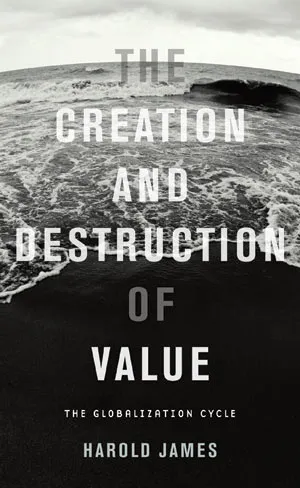
The Creation and Destruction of Value
Harold James The Creation and Destruction of Value: The Globalization Cycle Harvard University Press 252 pages, 4 3/8 x 7 1/8 inches ISBN 978 0674035843
Available here →November 9, 2009
20091109-james-harold-on-creation-destruction-value-globalization-cycle-3
A close-up
The rest of this thread

Marie Louise James
Harold James
Harold James holds a joint appointment as Professor of History and International Affairs at the Woodrow Wilson School, Princeton University, and as Marie Curie Visiting Professor at the European University Institute. He was educated at Cambridge University (Ph.D. in 1982) and was a Fellow of Peterhouse for eight years before coming to Princeton University in 1986. His books include a study of the interwar depression in Germany, The German Slump (1986); and International Monetary Cooperation Since Bretton Woods (1996). He was also coauthor of a history of Deutsche Bank (1995), which won the Financial Times Global Business Book Award in 1996. More recent works include The End of Globalization: Lessons from the Great Depression (2001). In 2004 he was awarded the Helmut Schmidt Prize for Economic History, and in 2005 the Ludwig Erhard Prize for writing about economics.
Pull this thread
The present crisis is 1931, a banking crisis spreading by contagion, for which no macroeconomic answer exists.
Know something the rest of us don't?
Most threads on Rorotoko begin with our invitation. Any thread can begin with a proposal: you write it with the same prompts every thread answers, and we review it.
Propose a thread →