
Harold James
The Creation and Destruction of Value
Ten years ago, I began writing a book on the phenomenon of globalization, in part in order to try to understand the bitter debate which pitted globalization protesters against international institutions that were attempting to manage the inherently chaotic process of increased flows of goods, capital, and labor. How permanent and how stable was globalization?
The book that resulted from my reflections then, The End of Globalization, also published by Harvard University Press, in 2001, suggested that globalization was reversible, and that indeed in the interwar period the Great Depression had finally ended the sustained era of globalization that opened up with the steamship and the transatlantic cable in the second half of the nineteenth century.
In that book I also suggested that the anti-globalization protest movement had no widely appealing ideology that was capable of creating a new model of order supplanting globalization. In that sense the anti-globalization protest movement around the turn of the century was not analogous to the anti-system movements on the left and right that marked the interwar era, those of communists and fascists.
Ten years later, there is an obvious urgency about the crisis. The complaint against global institutions is not that they are too strong or too interventionist, that they detract from national sovereignty, but that they are too ineffective in the face of a financial crisis of a magnitude whose only precedent is in the Great Depression.
Editor: Erind Pajo
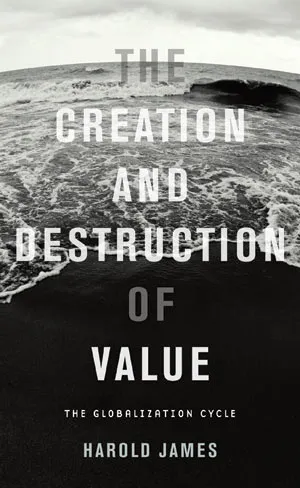
The Creation and Destruction of Value
Harold James The Creation and Destruction of Value: The Globalization Cycle Harvard University Press 252 pages, 4 3/8 x 7 1/8 inches ISBN 978 0674035843
Available here →November 9, 2009
20091109-james-harold-on-creation-destruction-value-globalization-cycle-2
The wide angle
The rest of this thread

Marie Louise James
Harold James
Harold James holds a joint appointment as Professor of History and International Affairs at the Woodrow Wilson School, Princeton University, and as Marie Curie Visiting Professor at the European University Institute. He was educated at Cambridge University (Ph.D. in 1982) and was a Fellow of Peterhouse for eight years before coming to Princeton University in 1986. His books include a study of the interwar depression in Germany, The German Slump (1986); and International Monetary Cooperation Since Bretton Woods (1996). He was also coauthor of a history of Deutsche Bank (1995), which won the Financial Times Global Business Book Award in 1996. More recent works include The End of Globalization: Lessons from the Great Depression (2001). In 2004 he was awarded the Helmut Schmidt Prize for Economic History, and in 2005 the Ludwig Erhard Prize for writing about economics.
Pull this thread
Today's crisis is not 1929 but 1931, a banking crisis with no quick macroeconomic fix.
Know something the rest of us don't?
Most threads on Rorotoko begin with our invitation. Any thread can begin with a proposal: you write it with the same prompts every thread answers, and we review it.
Propose a thread →