
Eli Berman
Radical, Religious, and Violent
Why are the Taliban such a threat in Afghanistan? And why are violent radical Islamists such resilient terrorists? You won’t believe this but the answer is communism. I’m not kidding. Not capital C Communism, the discredited ideology of the Soviet Union, but mutual aid, as practiced in communes. This might sound like a joke from The Colbert Report—but stick with me.
Religious extremists such as the Taliban are incredibly successful rebels. The Taliban controlled Afghanistan, and we now know how hard that is. Their success cannot be solely due to the Taliban’s theology, which is shared by many rebel groups, most of which are flimsy organizations that quickly crumble.
So what is the Taliban’s secret? Well, the single biggest threats to terrorist organizations are leaks and defection. Radical religious organizations tend to succeed because they can select recruits carefully to create defection-resistant organizations. How do they resist defection? Communism. Religious radicals, such as the Amish, Hutterites, and Ultra-Orthodox Jews, are masters of mutual aid, creating tight-knit communities that are incredibly supportive of their members.
Yet economists (like me) know that mutual aid shouldn’t work in large communities, since individuals pursuing their own self-interest will shirk their responsibilities to the commune, which will then unravel. In fact, mutual aid communes generally do unravel. But not those run by religious radicals—they carefully select new members and monitor the behavior or existing members through sacrifices and prohibitions. The latter are surprisingly similar among religious radicals of vastly different religious traditions. (Economists call that structure a “club,” and Larry Iannaccone of Chapman University is responsible for the insight.)One more logical step: Once the shirking problem is solved in the mutual aid community, controlling defection is much easier in the violent sub-group—since members have been screened for loyalty and are well-monitored.
What’s the evidence for this communist conspiracy? Religious radicals with a social-service provision base, such as Hamas, Hezbollah, Sadr’s Mahdi Army, and the Taliban, are much more effective at violence than groups that share the same theology but lack a service provision base, such as the Palestinian Islamic Jihad.
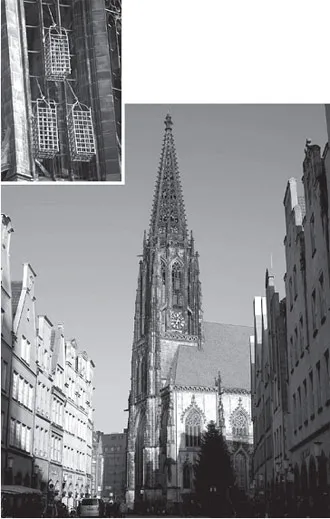
St. Lambert’s Cathedral in Münster, Germany, reproduced in the book on page 210. Above the clock are three cages where the bodies of Anabaptist rebel leader Jan Bockelson and others were left to rot. The Münster rebellion established a theocracy in the city in 1532. It was violently suppressed in June 1535 (Al Chernov, inset- Rudiger Wolk).
Editor: Erind Pajo
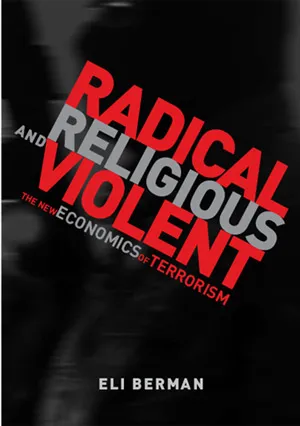
Radical, Religious, and Violent
Eli Berman Radical, Religious, and Violent: The New Economics of Terrorism MIT Press 280 pages, 9 x 6 inches ISBN 978 0262026406
Available here →December 14, 2009
20091214-berman-eli-on-radical-religious-violent-new-economics-of-terrorism-1-1
In a nutshell
The rest of this thread

Eli Berman
Eli Berman is an associate professor of economics at UC San Diego, research director for international security studies at the UC Institute on Global Conflict and Cooperation, and a research associate at the National Bureau of Economic Research. His research interests include economic development and conflict, the economics of religion, and labor economics. Grants from the National Science Foundation, Homeland Security and the Defense Department have enabled him to study religion, fertility, governance, and insurgency. His latest publications are “Religion, Terrorism, and Public Goods: Testing the Club Model,” with David Laitin, in the Journal of Public Economics (2008), and “The Economics of Religion,” with Laurence Iannaccone, in the New Palgrave Encyclopedia of Economics. Berman received his Ph.D. in economics from Harvard University. He twitters a real time annotated bibliography at “clubmodel.”
Pull this thread
Mutual-aid structure makes radical religious groups lethal, so governments should compete with them in providing benign services.
Know something the rest of us don't?
Most threads on Rorotoko begin with our invitation. Any thread can begin with a proposal: you write it with the same prompts every thread answers, and we review it.
Propose a thread →