
Eli Berman
Radical, Religious, and Violent
My book offers a fresh way of understanding insurgency and terrorism. I outline a constructive approach to confronting localized insurgencies like those in Afghanistan and Pakistan, and the international terrorism that now threatens most Western countries.
The threat is limited to a very small number of organizations, only those capable of sustainable violent acts without leaks and defection. The U.S. State Department lists only 39 such organizations—less than half are radical Islamists. So why not concentrate on undermining the benign organizational bases of these few organizations? This is best done by helping host governments compete directly in the provision of the benign services that radical Islamists provide to their members: security, education, health care, justice, welfare services, and political representation.
Has this approach ever worked? Gamal Abdul Nasser managed it in the 1950s when he confronted the Egyptian Muslim Brotherhood, the prototypical modern radical Islamists. Nasser’s arresting of thousands of leaders is pretty standard—but he also nationalized the vast social service provision network that the Brotherhood had developed, successfully suppressing them for over two decades.
This constructive tactic has additional advantages. It carries no ideological baggage; allies, local governments, and NGOs can wholeheartedly sign on. It also plays to the strengths of western democracies: our resources and capacity for strong governance and economic growth.
If improving governance works, then why is Afghanistan going so badly? Perhaps because we misunderstand the enemy.
In Iraq the insurgents may have been less a club, and so succumbed to a more standard “hearts and minds” governance and security enhancement approach, in which noncombatants rat out insurgents. The Taliban in Afghanistan may be more defection-proof, leaking less information. Undermining their organizational strength would require competing directly with their organizational base, which is currently outside Pakistan, in North Waziristan and Baluchistan.
Is this all just a liberal rant? No. It’s based on peer-reviewed empirical research published in scholarly journals. It is also informed by my own experience as a counterinsurgent and by conversations and consultation with current practitioners.
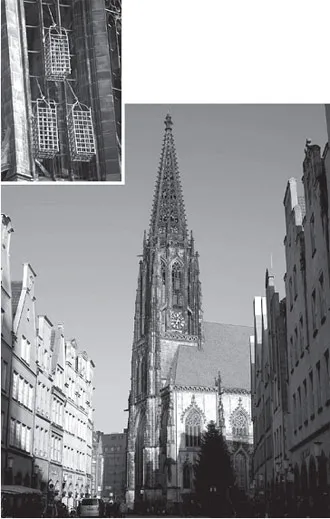
St. Lambert’s Cathedral in Münster, Germany, reproduced in the book on page 210. Above the clock are three cages where the bodies of Anabaptist rebel leader Jan Bockelson and others were left to rot. The Münster rebellion established a theocracy in the city in 1532. It was violently suppressed in June 1535 (Al Chernov, inset- Rudiger Wolk).
Editor: Erind Pajo
Radical, Religious, and Violent
Eli Berman Radical, Religious, and Violent: The New Economics of Terrorism MIT Press 280 pages, 9 x 6 inches ISBN 978 0262026406
Available here →December 14, 2009
20091214-berman-eli-on-radical-religious-violent-new-economics-of-terrorism-2
The wide angle
The rest of this thread

Eli Berman
Eli Berman is an associate professor of economics at UC San Diego, research director for international security studies at the UC Institute on Global Conflict and Cooperation, and a research associate at the National Bureau of Economic Research. His research interests include economic development and conflict, the economics of religion, and labor economics. Grants from the National Science Foundation, Homeland Security and the Defense Department have enabled him to study religion, fertility, governance, and insurgency. His latest publications are “Religion, Terrorism, and Public Goods: Testing the Club Model,” with David Laitin, in the Journal of Public Economics (2008), and “The Economics of Religion,” with Laurence Iannaccone, in the New Palgrave Encyclopedia of Economics. Berman received his Ph.D. in economics from Harvard University. He twitters a real time annotated bibliography at “clubmodel.”
Pull this thread
Radical religious groups are lethal because of their mutual-aid structure, not their theology.
Know something the rest of us don't?
Most threads on Rorotoko begin with our invitation. Any thread can begin with a proposal: you write it with the same prompts every thread answers, and we review it.
Propose a thread →