
Eli Berman
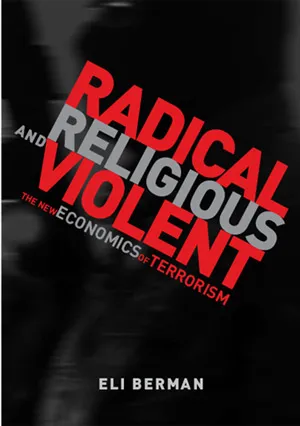
Radical, Religious, and Violent
The final chapter of Radical, Religious, and Violent examines religious radicalism in a historical context. Having established earlier in the book why religious radicals can be lethal terrorists and especially effective rebels if they so choose, I proceed to examine the sources of religious radicalism.
Adam Smith, the originator of modern economics, was concerned about religious freedom and political violence. “Times of violent religious controversy have generally been times of equally violent political faction,” wrote Smith in 1776.
And Menno Simons, the original Mennonite, railed like a modern Jihadist against the corruption and moral bankruptcy of the established order. Consider Simons’s words in his 1539 Foundation of Christian Doctrine:“We find in your houses and courts nothing but sparkling pomp and showy dress, boldness and presumptuousness of heart, insatiable avarice, hatred and envy, backbiting, betraying, harloting, seduction, gaming, carousing, dancing, swearing, stabbing, and violence…. The pitiful moaning and misery of the wretched men does not reach your ears. The sweat of the poor we find in your house, and the innocent blood on your hands.”
The Mennonites are pacifists today, though their fellow Anabaptists were often violent in the chaotic period during which both sects first emerged. Anabaptist sects were cruelly repressed in Europe, even when they practiced strict pacifism. Why are some religious radicals benign, like the present day Amish, while others are violent, like Hezbollah, Lashkar e Taiba, or the Münster rebels of 1532? To answer those questions I return to Menno Simons and the sixteenth-century European roots of modern Christian religious radicalism, looking for lessons for how governments should approach twenty-first-century radical Islam.
Surprisingly, Adam Smith and David Hume, the giants of eighteenth-century social science, each had an answer. Hume argued for state religion, as it would transform rabble-rousing clerics into harmless and indolent civil servants. Smith made a classic argument for religious freedom, on the grounds that competition would breed tolerance. In retrospect, countries that have followed Smith’s advice about competitive markets and religious tolerance have created a shared juggernaut of prosperity, technological progress and cultural creativity.
This book is freakonomics about terrorism and insurgency, an attempt to apply an economist’s toolkit to these urgent threats. What’s in that toolkit? Behavioral models that assume rational individuals generate testable propositions, which are then exposed to data. We then keep the models that are not refuted (and quietly suppress the rest).
Amazingly enough, this works. We can explain much of the surprising behavior of religious radicals (benign and violent) with economic reasoning. Moreover, that reasoning has testable implications that survive exposure to data. Most importantly, this same logic suggests that religious radicals respond to incentives, so that we can contain the threat posed by violent religious radicals through methods that complement coercive force with constructive, incentive-based methods. Those constructive methods range from rewards for defection to targeted programs to improve governance.

St. Lambert’s Cathedral in Münster, Germany, reproduced in the book on page 210. Above the clock are three cages where the bodies of Anabaptist rebel leader Jan Bockelson and others were left to rot. The Münster rebellion established a theocracy in the city in 1532. It was violently suppressed in June 1535 (Al Chernov, inset- Rudiger Wolk).
Editor: Erind Pajo
Radical, Religious, and Violent
Eli Berman Radical, Religious, and Violent: The New Economics of Terrorism MIT Press 280 pages, 9 x 6 inches ISBN 978 0262026406
Available here →December 14, 2009
20091214-berman-eli-on-radical-religious-violent-new-economics-of-terrorism-3
A close-up
The rest of this thread

Eli Berman
Eli Berman is an associate professor of economics at UC San Diego, research director for international security studies at the UC Institute on Global Conflict and Cooperation, and a research associate at the National Bureau of Economic Research. His research interests include economic development and conflict, the economics of religion, and labor economics. Grants from the National Science Foundation, Homeland Security and the Defense Department have enabled him to study religion, fertility, governance, and insurgency. His latest publications are “Religion, Terrorism, and Public Goods: Testing the Club Model,” with David Laitin, in the Journal of Public Economics (2008), and “The Economics of Religion,” with Laurence Iannaccone, in the New Palgrave Encyclopedia of Economics. Berman received his Ph.D. in economics from Harvard University. He twitters a real time annotated bibliography at “clubmodel.”
Pull this thread
Mutual-aid structure makes radical religious groups lethal, so governments should compete with them in providing benign services.
Know something the rest of us don't?
Most threads on Rorotoko begin with our invitation. Any thread can begin with a proposal: you write it with the same prompts every thread answers, and we review it.
Propose a thread →