
Kirk Savage
Monument Wars
The monumental core of Washington, D.C. is a great axis of public space, almost two miles long, stretching from the Grant Memorial below the U.S. Capitol building to the Lincoln Memorial overlooking the Potomac River. With the mammoth obelisk of the Washington Monument in the center, anchoring its formal geometry, the National Mall looks like it has been there forever. It has become almost a work of nature: in the words of Paul Goldberger, “as essential a part of the American landscape as the Grand Canyon.”
Few visitors to the U.S. capital realize how recent, fragile, and contested this achievement actually is. The monumental core of America is a modern invention of the mid-twentieth century. Realized amid ecological destruction and public controversy, the National Mall is part of a larger transformation of the memorial landscape of Washington and of the nation. Monument Wars tells the story of this sea change in national representation.
Public monuments emerged in the nineteenth century in a loosely connected system of “public grounds”—a decentralized landscape of heroic statues spread out in traffic circles and picturesque parks. The twentieth century witnessed the birth of “public space.” In Washington this resulted in a new spatial system that concentrated authority in an intensified center and demanded a novel psychological engagement from the citizen. In the process, the very idea of the monument changed profoundly, from an object of reverence to a space of experience.
The shift from public ground to public space has had unforeseen consequences, introducing tragedy and trauma into the memorial landscape and leaving Americans now with multiple paradoxes of national identity in an era of increasing global insecurity.
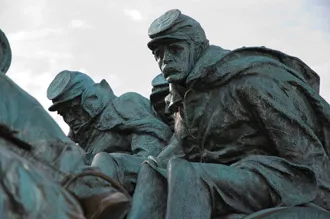
Detail of the Grant Memorial; photo by the author.
Editor: Erind Pajo
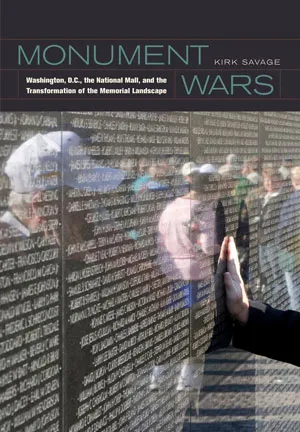
Monument Wars
Kirk Savage Monument Wars: Washington, D.C., the National Mall, and the Transformation of the Memorial Landscape University of California Press 408 pages, 10 x 7 inches ISBN 978 0520256545
Available here →March 3, 2010
20100303-savage-kirk-on-monument-wars-washington-dc-national-mall-memorial-1-1
In a nutshell
The rest of this thread

Kirk Savage
Kirk Savage is professor of the history of art and architecture at the University of Pittsburgh. He has been writing on public monuments for over twenty-five years. His first book, Standing Soldiers, Kneeling Slaves: Race, War, and Monument in Nineteenth-Century America, won the 1998 John Hope Franklin Publication Prize as best book in American Studies. In addition to academic publishing, he contributes opinion pieces and book reviews to the Washington Post.
Pull this thread
The monumental core of Washington is a mid twentieth-century invention, and clearing the Mall was early urban renewal.
Know something the rest of us don't?
Most threads on Rorotoko begin with our invitation. Any thread can begin with a proposal: you write it with the same prompts every thread answers, and we review it.
Propose a thread →