
Adrian Johns
Death of a Pirate
A casual browser could do worse than start around p.189, with the story of Oliver Smedley and Kitty Black’s raid on the Shivering Sands fort.
Shivering Sands was an old World War II anti-aircraft installation sited a few miles offshore from the Thames Estuary in southern England. It comprised a set of rusting metal chambers atop 60-foot legs, linked by rickety walkways. The complex had been abandoned after the war, but had recently been commandeered by a pirate radio outfit called Radio City. City’s boss, Reg Calvert, had arranged for a huge aerial to be built atop the fort, and begun broadcasting pop music into London. Smedley’s rival pirate radio broadcaster was by this point facing collapse, and he saw the facility as his last chance to salvage his dream of a commercial broadcasting operation capable of beating the BBC. He decided to take it over. He and Black organized a gang of stevedores to capture the fort, which they did at the dead of night.
It was this raid that brought about the fatal confrontation with Calvert. It ended only a week later, after the dockers and DJs had spent a week in enforced proximity aboard Shivering Sands.
By that time Calvert had met with Smedley and Black, and leveled a series of bizarre threats against them—including an announcement that he had invented a deadly form of nerve gas and was hoping to use it against the usurpers.
On the night of June 21, he showed up at Smedley’s country house, and after a brief altercation—the details of which remain murky to this day—his rival shot him dead.
By the time the dockers left Shivering Sands a few days later, Smedley was facing a murder charge, and the British government had set in train the measures that would end the golden age of Sixties pirate radio.
This part of the book tells the story of the plot, the killing, and their consequences. It is quite a dramatic tale, involving skullduggery, threats, fantasy, and, in the end, tragic violence.
But it also has a broader point, because these events led to a transformation in Britain’s sound broadcasting.
The significance of the book lies in two main areas.
One has to do with the meanings of “public service” media in modern societies.
In the UK, the BBC was founded and maintained with the purpose of being a “public corporation,” dedicated to using the airwaves to enhance the culture of the nation. It was controversial from the outset, but by the 1930s it had a reputation great enough that many saw it as a model for the future of the national economy itself. Politicians began to argue that industries like transport and energy should be reorganized into institutional forms resembling the BBC.This meant that in the mid-twentieth century critics of the emerging welfare state often saw the BBC as the lynchpin of the culture they were attacking. For Smedley, who was such a critic, launching a pirate radio station was of a piece with creating a think-tank, the Institute of Economic Affairs, dedicated to combating the social-democratic consensus of postwar politics.
The debate over public service media that peaked with the pirate radio boom of the Sixties was thus a debate over the trajectory of modern politics itself. And right now, with the fate of public broadcasting once more in the balance, this part of the story has lessons that we could do with learning all over again.
The other area of the book’s significance relates to the character of the information age.
Some of the protagonists of the book were the first experts to predict this coming of an information economy. They pioneered skeptical approaches to the principles of intellectual property that structure and, to some extent, constrain that economy. Moreover, the community of amateur experimenters that competed with the BBC for the use of the ether in the 1920s and 1930s forged ideals of sharing and technocratic libertarianism that would later become the ideals of the digerati. The moral convictions of today’s digital communities derive from those earlier challengers to “big media.”
In 1966, two ideas of media piracy—conservative and experimental—came head to head. In the short run, the conservative won. But in a longer-term view the experimental tradition represented by Calvert and the 1920s radio amateurs may well turn out to have been more important. The world of networked digital creativity might have been very different if it had not existed.
Editor: Erind Pajo
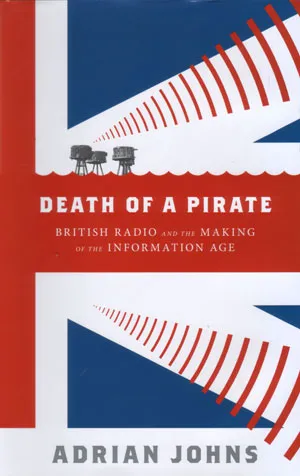
Death of a Pirate
Adrian Johns Death of a Pirate: British Radio and the Making of the Information Age W. W. Norton 305 pages, 9¼ x 6½ inches ISBN 978 0393068603
Available here →December 8, 2010
20100510-johns-adrian-on-piracy-intellectual-property-wars-gutenberg-gates-3
A close-up
The rest of this thread

Adrian Johns
Adrian Johns is Professor of History and Chair of the Committee on Conceptual and Historical Studies of Science at the University of Chicago. Educated at the University of Cambridge, he also taught at CalTech and the University of California, San Diego. Besides the books featured in his Rorotoko interviews, Death of a Pirate and Piracy, he is also the author of The Nature of the Book: Print and Knowledge in the Making (1998).
Pull this thread
Today's digital communities inherit their ethos of sharing from the radio experimenters who fought the BBC monopoly.
Know something the rest of us don't?
Most threads on Rorotoko begin with our invitation. Any thread can begin with a proposal: you write it with the same prompts every thread answers, and we review it.
Propose a thread →