
Adrian Johns
Piracy
On page 343 one meets Frederick Willetts, the self-proclaimed Pirate King of Edwardian London. In the early years of the twentieth century, Willetts ran a “People’s Music Publishing Company” in East London that issued pirated popular music in millions of copies, distributing it across the country.
The music industry employed its own private army of “commandoes” to track him down, which they eventually succeeded in doing, but not before the industry had effectively ceased publishing songs in protest at his effects.
What is remarkable is that when Parliament launched an inquiry into pirated music, Willetts volunteered to come to Westminster and testify. This is, I think, the only time in history when a self-proclaimed pirate has shown up at a center of power and mounted an explicit, populist defense of piracy itself.
Willetts’s case bears examination, because many of the elements of later music pirates, including the digital ones, can be seen in embryo in his declarations. For example, he condemned the orthodox industry as monopolistic, hidebound, and dedicated to elite customers at the expense of the working class. And he proposed market segmentation as an appropriate way forward—another line that has been revived in recent years.
Willetts’s bravado gesture—which did him little good, incidentally, as he was jailed shortly after—exemplifies the point that major convictions of today can be traced back to controversies about piracy in previous decades. It throws unfamiliar light on the familiar, and encourages us to rethink our assumptions about what is permanent and what changeable. And Willetts himself exemplifies the kind of colorful personality that Piracy repeatedly finds at the heart of these controversies.
Piracy is really full of stories; this is but one favorite.
I hope that the book will encourage protagonists in today’s intellectual-property debates to think more deeply and broadly than they usually do about what is at stake and how we might move forward.
Often very passionate, those debates take place on grounds of policy and law. That makes sense, of course. But it also means that present intellectual property debates leave untouched what are important, perhaps even essential, constituents of the issues at hand. That is, IP in practice is a matter of custom and convention as much as it is of law per se.
If we neglect that fact, our responses to what everyone agrees to be a crisis in the field are likely to be deficient, and quite possibly even damaging.
The upholders of ever-stronger IP protections in particular tend to make this mistake. Their arguments about the practical effects of such protections rest largely on political-economic theories and models.
We need profound engagement with how IP operates in practice. And a necessary part of that engagement must be an appreciation of how the nature and effects of intellectual property have changed over time. That is, the intellectual property wars need some historical insight if they are not to be waged interminably.
Piracy makes that argument. And it further shows that an historical understanding can suggest why our current disputes are so intractable.
By identifying the emergence of an “intellectual property defense industry” the book calls attention to a social and economic phenomenon that has gone largely unrecognized, but which in fact lies at the heart of the problem.
Editor: Erind Pajo
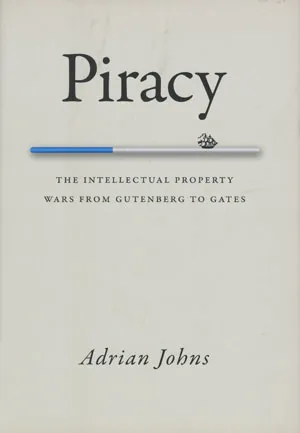
Piracy
Adrian Johns Piracy: The Intellectual Property Wars from Gutenberg to Gates University of Chicago Press 640 pages, 9 x 6 inches ISBN 978 0226401188
Available here →May 10, 2010
20101208-johns-adrian-on-death-pirate-british-radio-making-information-age-3
A close-up
The rest of this thread

Adrian Johns
Adrian Johns is Professor of History and Chair of the Committee on Conceptual and Historical Studies of Science at the University of Chicago. Educated at the University of Cambridge, he also taught at CalTech and the University of California, San Diego. Besides the books featured in his Rorotoko interviews, Death of a Pirate and Piracy, he is also the author of The Nature of the Book: Print and Knowledge in the Making (1998).
Pull this thread
Copyright, patents and the idea of intellectual property itself came out of fights over piracy.
Know something the rest of us don't?
Most threads on Rorotoko begin with our invitation. Any thread can begin with a proposal: you write it with the same prompts every thread answers, and we review it.
Propose a thread →