
Adrian Johns
Piracy
Piracy is about how today’s world of intellectual property came into being through half a millennium of conflict.
Beginning in early modern Europe, the book traces the emergence of the laws and customs that structure the information economy. The story it tells ranges from the streets of Milton’s London to the computer labs of MIT and the backstreets of Beijing.
I show how struggles over so-called piracy have consistently driven the development of new practices and concepts. The laws of copyright and patenting—and even the concept of intellectual property itself—resulted from such struggles. At the same time, the debates that piracy triggered also shaped major elements of modern culture—including the Enlightenment itself, science, and the media.
Piracy also traces the emergence of a private policing industry devoted to forestalling or detecting piracy—an industry that has itself repeatedly skirted illegality in its methods.
The book ends in the present day, with a speculation that the age of intellectual property may be coming to an end. The combination of a networked economy that challenges the basic foundations of intellectual property monopolies and a growing backlash against excessive anti-piracy policing may well lead to a revolution in this sphere as great as that which led to the invention of intellectual property itself.
At that point, the convictions and arguments that structured the prior half-millennium of the history of intellectual property will become “live” once again; understanding them may well help us to find a way forward. It is in that light that I would hope readers will approach Piracy: as history, certainly, but as history with consequences.
Editor: Erind Pajo
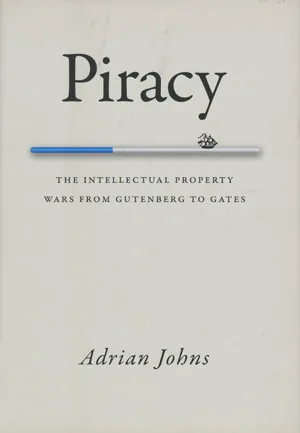
Piracy
Adrian Johns Piracy: The Intellectual Property Wars from Gutenberg to Gates University of Chicago Press 640 pages, 9 x 6 inches ISBN 978 0226401188
Available here →May 10, 2010
20101208-johns-adrian-on-death-pirate-british-radio-making-information-age-1-1
In a nutshell
The rest of this thread

Adrian Johns
Adrian Johns is Professor of History and Chair of the Committee on Conceptual and Historical Studies of Science at the University of Chicago. Educated at the University of Cambridge, he also taught at CalTech and the University of California, San Diego. Besides the books featured in his Rorotoko interviews, Death of a Pirate and Piracy, he is also the author of The Nature of the Book: Print and Knowledge in the Making (1998).
Pull this thread
pulls againstpulls alongside
Copyright, patents and the idea of intellectual property itself came out of fights over piracy.
Against RF · AI will shrink the pool of material eligible for intellectual property protection and drain value from protection itself. On: Copying and imitation are a lapse from originality rather than constitutive of making
Against DS · Every single-factor answer to genius is wrong on its own, because each is half of a paradox. On: Copying and imitation are a lapse from originality rather than constitutive of making
Alongside MO · Forgery is a legitimate artistic practice, and the forgery is the masterpiece's dark double. On: Copying and imitation are a lapse from originality rather than constitutive of making
Alongside ER · Sake has never been a fixed tradition, and pairing it with particular foods is a recent import from wine culture. On: Copying and imitation are a lapse from originality rather than constitutive of making
Alongside MB · Herding is not mindless, but it is now maladaptive more often than adaptive, so contrarians need institutional protection. On: Copying and imitation are a lapse from originality rather than constitutive of making
Alongside MB · Copying is constitutive of being human, not a lapse from originality. On: Copying and imitation are a lapse from originality rather than constitutive of making
Know something the rest of us don't?
Most threads on Rorotoko begin with our invitation. Any thread can begin with a proposal: you write it with the same prompts every thread answers, and we review it.
Propose a thread →