
Maurice Samuels
Inventing the Israelite
Chapter two of the book focuses on the writer Ben-Lévi (the pseudonym of Godchaux Weil, 1806-1878) who published a dozen short stories, as well as many non-fiction pieces, in the reform Jewish newspaper, Les Archives Israélites, in the 1840s. Originally from Alsace, Weil’s father was a prosperous porcelain manufacturer and a leader of the Parisian Jewish community. His nephew was perhaps the most famous of all modern French writers—Marcel Proust. Written entirely in French, the articles in Les Archives Israélites targeted an acculturated, elite readership, eager to modify Jewish religious practice and tradition in order more fully to embrace the opportunities offered to them by France’s revolutionary granting of citizenship.Ben-Lévi’s fiction theorizes the nature of this transition, extolling the advantages of emancipation while exhorting readers to remain loyal to a newly modernized Judaism. Written in the new descriptive style of Balzac that critics at the time were beginning to label “realist,” Ben-Lévi’s stories stand out from the other articles in the newspaper, which tend to flatter the ethnic pride of the community, by asking readers to contemplate what they have left behind in their social ascent.One story from 1841 entitled “The Rise and Fall of a Polish Taleth,” narrates the adventures of a prayer shawl as it gets handed down through three generations of a Parisian Jewish family. The story opens in the 1780s, as the very orthodox Père Jacob, an iron dealer, imports a taleth from Poland for his wedding. Upon his death, the prayer shawl passes to his son Jacobi, an officer in Napoleon’s army, who is “much less religious” than his father but nevertheless venerates the taleth as a link to family tradition. By the time it reaches Jacobi’s son, a fashionable French gentleman who calls himself Jacoubé “in order to dissimulate entirely his israelite origin,” the taleth has become a mere piece of cloth, devoid of both familial and religious significance. At the end of the story, we learn that Jacoubé has given it to a prostitute to wear to a costume ball.Whereas the taleth story functions as a modern parable criticizing the losses entailed by the assimilation process, Ben-Lévi holds out hope in his other stories for a renewed appreciation of the Jewish tradition. In a story from 1846, called “The Fish and the Breadcrumbs,” an assimilated skeptic named Gustave learns to respect the Jewish religion by watching a widow comfort her young son through the performance of a religious ritual. The spiritual awakening of Ben-Lévi’s character has little to do with the supernatural or with God as such, but rather with a new understanding of the way Jewish tradition forges ethical bonds linking human beings in spite of the pressures of capitalist modernity. In the conclusion to the book, I ask how the rediscovery of Ben-Lévi’s fiction might help us to understand what his much more famous great-nephew, Marcel Proust, had to say about Jews and Judaism. I show how both writers ask very similar questions about what it means to be a Jew in the absence of religious faith, inherited tradition, or legal strictures. I suggest that Proust’s character Swann, an assimilated Jew who “returns to the spiritual fold of his fathers” as a result of the Dreyfus Affair, becomes a kind of modern(ist) version of Gustave, Ben-Lévi’s reformed cynic.Taken together, this fiction helps us reconsider what we thought we knew about Jewish history and literature. It reveals that nineteenth-century French Jews envisioned other fates for themselves besides assimilation and homogenization. In the mid-nineteenth century, at a time when French Jews were first beginning to take advantage of the new opportunities offered to them, they sought out creative ways to become French while remaining Jews and to express their difference in the public sphere. This literature also helps us reconsider what we thought we knew about French history and literature. These writers were very likely the first members of a minority religious or ethnic group in France to describe that group’s experience in fiction. They thus reveal that difference inhabited modern French literature from the start, and provide a useful historical context for examining current examples of minority or postcolonial fiction, which concerns itself with very similar issues.Moreover, these Jewish writers help us re-evaluate the tradition of French universalism, which is often seen as hostile to all forms of minority identity. By showing how these Jewish writers attempted to reconcile their particular identities with the French universalist tradition, or to substitute a Jewish form of the universal in place of what they felt to be the Christian one of the dominant culture, I indicate that nineteenth-century French universalism was far less monolithic and hegemonic, far more malleable and adaptable, than has previously been supposed.The recent “return of religion” in France has made these issues newly topical. The last few decades have seen fierce clashes over the role of religion in contemporary society, as France has struggled to accommodate the increasingly vocal demands of its religious (and ethnic) minorities. The 1989 “Affaire des foulards,” or head-scarf controversy, in which French Muslim girls fought unsuccessfully for the right to wear head coverings in public schools, demonstrates how fraught the question of laïcisation continues to be in France.While I do not address such recent issues in my book, it is my hope that the nineteenth-century debates around Jews and Judaism will provide a useful historical context for understanding current controversies.
Editor: Erind Pajo
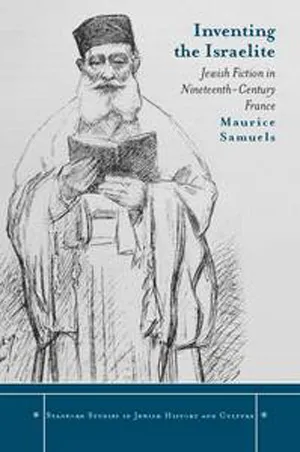
Inventing the Israelite
Maurice Samuels Inventing the Israelite: Jewish Fiction in Nineteenth-Century France Stanford University Press 336 pages, 9 x 6 1/4 inches ISBN 978 0804763844
Available here →July 5, 2010
20100705-samuels-maurice-on-invent-israelit-jewish-fiction-19century-france-3
A close-up
The rest of this thread

Nina Davenport
Maurice Samuels
Maurice Samuels is Professor of French at Yale University. He was born in Chicago and received his Ph.D. from Harvard University. In addition to Inventing the Israelite: Jewish Fiction in Nineteenth-Century France, featured in his Rorotoko interview, he is the author of The Spectacular Past: Popular History and the Novel in Nineteenth-Century France (Cornell, 2004). His Nineteenth-Century Jewish Literature Reader (Stanford, forthcoming 2011), co-edited with Jonathan Hess and Nadia Valman, will feature many of the novels and short stories discussed in Inventing the Israelite in his own translations. Currently, Samuels is working on French Philosemitism, or positive discourse on Jews, from the Revolution to the present.
Pull this thread
A French Jewish literature existed half a century before Dreyfus, and it shows emancipated Jews refused assimilation.
Know something the rest of us don't?
Most threads on Rorotoko begin with our invitation. Any thread can begin with a proposal: you write it with the same prompts every thread answers, and we review it.
Propose a thread →