
Maurice Samuels
Inventing the Israelite
In 1790-91, France became the first European country to make the Jews full and equal citizens. Considered a backward population in need of “regeneration” by Enlightenment reformers, the French Jews transformed over the course of the next hundred years into a modernizing vanguard, spearheading many of the social, economic, and political changes that helped make Paris into the “capital of the nineteenth century.”
Inventing the Israelite examines the fiction produced in the mid-nineteenth century (1830-1870) by the first generation of Jews to be born as French citizens. These writers include Eugénie Foa, Ben-Lévi (pseud. Godchaux Weil), Ben Baruch (pseud. Alexandre Créhange), Alexandre Weill, Daniel Stauben (pseud. Auguste Widal), and David Schornstein. Mostly unknown to scholars, their novels and short stories provide unique insight into a community in the throes of momentous change.
I argue that these nineteenth-century French Jewish writers used fiction to come to terms with the possibilities—and pitfalls—presented by emancipation, and as a kind of laboratory for the invention of modern Jewish identity. They did so by bringing the forms of the French literary tradition to bear on the central problems facing modern Jews. The result is unique in both French and Jewish literary history.
My book begins with an introduction that outlines modern French Jewish history and explains the factors—including early emancipation—that made the French Jews unique among their European coreligionists. The core of Inventing the Israelite is five chapters, each centered on a writer who epitomizes a different point on the Jewish ideological spectrum of the time—a different answer to the problem of how to be Jewish in modern France.
These answers range from apostasy to orthodoxy, from advocating intermarriage and conversion to maintaining strict adherence to Jewish laws and traditions. In between these two extremes, other writers advocate through their fiction for religious reform as well as for more idiosyncratic ways of becoming a modern Jew. Still others sought to redefine Jewishness in secular terms, leaving behind religious practice for a more historical form of identity.
In the conclusion, I skip forward to the early twentieth century to show how the fiction of Marcel Proust perpetuates the legacy of these nineteenth-century Jewish writers by asking very similar questions about what it means to be a Jew in modern France.
Editor: Erind Pajo
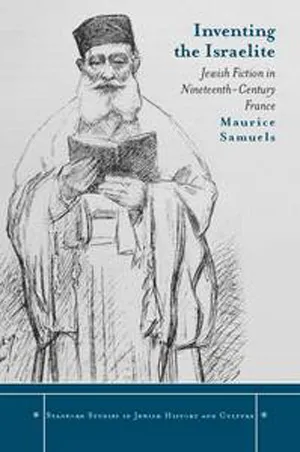
Inventing the Israelite
Maurice Samuels Inventing the Israelite: Jewish Fiction in Nineteenth-Century France Stanford University Press 336 pages, 9 x 6 1/4 inches ISBN 978 0804763844
Available here →July 5, 2010
20100705-samuels-maurice-on-invent-israelit-jewish-fiction-19century-france-1-1
In a nutshell
The rest of this thread

Nina Davenport
Maurice Samuels
Maurice Samuels is Professor of French at Yale University. He was born in Chicago and received his Ph.D. from Harvard University. In addition to Inventing the Israelite: Jewish Fiction in Nineteenth-Century France, featured in his Rorotoko interview, he is the author of The Spectacular Past: Popular History and the Novel in Nineteenth-Century France (Cornell, 2004). His Nineteenth-Century Jewish Literature Reader (Stanford, forthcoming 2011), co-edited with Jonathan Hess and Nadia Valman, will feature many of the novels and short stories discussed in Inventing the Israelite in his own translations. Currently, Samuels is working on French Philosemitism, or positive discourse on Jews, from the Revolution to the present.
Pull this thread
A French Jewish literature existed half a century before Dreyfus, and it shows emancipated Jews refused assimilation.
Know something the rest of us don't?
Most threads on Rorotoko begin with our invitation. Any thread can begin with a proposal: you write it with the same prompts every thread answers, and we review it.
Propose a thread →