
Gary Stuart
Innocent Until Interrogated
With regard to the larger picture, my book chronicles moral and legal conflicts, political intrigue, retribution, and drastic consequences—all of which were unintended. There is a dark evil here, smoldering under a blanket of law and order. The central driver in the first case was the MCSO’s utter refusal to accept the reality that two twitchy teenagers were capable of the brutality that resulted in the stark execution of nine helpless people.
In the second case, the MCSO saw evidence of guilt rather than symptoms of mental illness as they coerced a confession out of a man on his way to see his psychiatrist. He was an easily led camper, not a killer.
I wrote this book to help educated and inquiring adults get over the mentality that prevents many people from believing that innocent suspects can actually confess to crimes they did not commit.
A few confess because of some deep-seated compulsion—often for publicity, sometimes out of stupidity, and almost always out of fear. The suspects profiled in my book confessed because the police induced them to confess. It happens too often and in every state. And we let it happen because we do not believe it is possible.
But it does happen—even several innocent people do confess falsely to accusations of even mass murder. This is not a ponderous textbook. The book is scholarly, I hope, but not dogmatic. And I did not let the law get in the way of the facts.
I have avoided most of the academic jargon that surrounds books, including mine, about the law. And this is, partly, because one of America’s greatest constitutional lawyers, Larry Hammond, urged me to write in a way that would bring average Americans into America’s police stations.
Through this simple lens, the reader might come face to face with a contrived confession of guilt from a completely innocent person. I hope this may contribute more to the justice system than all the law reviews and law books I’ll ever write.
Editor: Erind Pajo
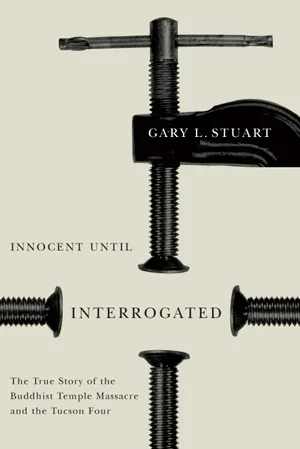
Innocent Until Interrogated
Gary Stuart Innocent Until Interrogated: The True Story of the Buddhist Temple Massacre and the Tucson Four University of Arizona Press 330 pages, 6 x 9 inches ISBN 978 0816529247
Available here →September 20, 2010
20100920-gary-stuart-innocent-interrogated-buddhist-temple-tuscon-massacre-2
The wide angle
The rest of this thread
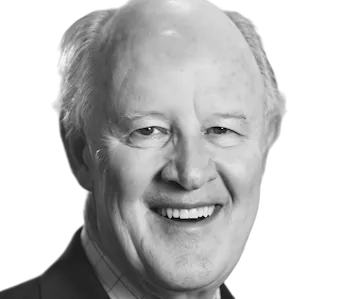
Gary Stuart
Gary Stuart earned degrees in business and law at the University of Arizona, served as an editor of the Arizona Law Review, and for thirty years practiced law at Jennings, Strouss, & Salmon, one of Arizona’s largest law firms. Early in his career, he began to teach, write, and lecture at both the local and national levels. He tried more than a hundred jury cases to a conclusion and earned the rank of Advocate as a juried member of the American Board of Trial Advocates. Stuart completed an eight-year term on the Arizona Board of Regents and served as its president from 2004 to 2005. His published work includes scores of law-review and journal articles, op-ed pieces, essays, stories, more than fifty Continuing Legal Education booklets, and six books, including Miranda: The Story of America’s Right to Remain Silent (University of Arizona Press, 2004). He is Senior Policy Advisor and Adjunct Professor of Law at Arizona State University’s Sandra Day O’Connor College of Law, where he teaches appellate advocacy, ethics, and legal writing.
Pull this thread
Innocent people confess to crimes as grave as mass murder because interrogators induce them to.
Know something the rest of us don't?
Most threads on Rorotoko begin with our invitation. Any thread can begin with a proposal: you write it with the same prompts every thread answers, and we review it.
Propose a thread →