
Gary Stuart
Innocent Until Interrogated
If I could gently nudge a browser in a bookstore to open Innocent Until Interrogated, I’d probably point her to the text on page 221.It’s only a few lines about what happens when someone kills, someone else investigates the killing, a prosecutor brings charges, and a judge empanels a jury to hear the case.I begin with the obvious: Murder trials fascinate the public, and many people see a confession to murder as the ideal civic solution. The perpetrator takes responsibility, and the public sleeps soundly. But murder trials rarely examine how the confession came into being: whether it is a product of the suspect’s guilty mind or of the interrogators’ will and perseverance.
Well-meaning jurors, like well-intentioned cops, sometimes fall victim to tunnel vision. Cops are tough, and they know the guy on the other side of the interrogation table is just as tough. The perp has been Mirandized, so let’s get on with it. In the atmosphere of suspicion that pervades the interrogation room, the cop comes to believe—despite the denials—that he did it. That belief grows and clouds the cop’s vision until that’s all he can see.And so it is with juries. A juror does not have any training for the job of being a juror. Jurors don’t have manuals to guide them. They have only a judge giving them instructions and expecting them to do their best.In the trial presented in this book, the State offered as evidence all seventeen of the audiotapes made during the interrogation of one defendant.
The jury heard his juvenile voice from high-fidelity headsets as he confessed to being there when the monks were killed. They heard him admit to planning the war game he said he thought was happening. They heard him admit to being in the temple when his two friends killed the monks. They heard him deny killing anyone. He confessed to being there, and the judge said that that was enough to find him guilty of felony murder. So they convicted him.But it was his words that convicted him, not his actions. And it was the audiotape that the jurors heard, not him. He never took the stand, never uttered a sound in open court for the three months of the trial.
Did it matter? Who cares, some may have said. A confession is a confession, right? But this jury, this particularly thoughtful jury, looked deeply at both the defendant and his interrogators. They acquitted the defendant of premeditated murder, based on his audiotape, while rejecting the accusations made by his “co-conspirator,” who was not on trial. That juvenile got a lenient plea bargain as the quid pro quo for testifying against his former high-school buddy.
The jury figured out what the investigators never did: It’s not always the confessor who did the deed; sometimes it’s the accuser. In the police station, the interrogators were the accusers. At trial, those same accusers represented the people of Arizona at the prosecution table. But this jury looked beyond the audiotapes. They measured the State’s witnesses. They balanced the State’s power against the defendant’s seeming helplessness in the interrogation chamber. Then they asked themselves the important question: Is this confession true, and was it made voluntarily?
As I say in the Epilogue, “The ordeals of Leo Bruce, Mike McGraw, Mark Nunez, Dante Parker, George Peterson, and Robert Armstrong are classic examples of the way some law enforcement agencies manipulate suspects, exploiting their vulnerability or their naiveté while ignoring hard evidence. Americans need to be wary of confessions in general and incensed by the ready acceptance of police-induced confessions by investigators, prosecutors, judges, and juries.”
I’m hardly alone in thinking that both true and false police-induced confessions raise important policy questions.In 2009, Professors Saul M. Kassin, Steven A. Drizin, Thomas Grisso, Gisli H. Gudjonsson, Richard A. Leo, and Allison D. Redlich collaborated in publishing a 118-page white paper modestly titled Police-Induced Confessions: Risk Factors and Recommendations.
These six highly regarded academics are among the most frequently published authors on the subject. Their combined work over the past two decades confirms what the academic world knows well—but the rest of the world has yet to perceive: Wrongful convictions based on false confessions have become epidemic.Their data prove the obvious: “False confessions raise serious questions concerning a chain of events by which innocent citizens are judged deceptive in interviews and misidentified for interrogation; waive their rights to silence and to counsel; and are induced into making false narrative confessions that form a sufficient basis for subsequent conviction.”
They urge us to commission a broad review of the state of the science on interviewing and interrogation. They suggest the need “to identify the dispositional characteristics (e.g., traits associated with Miranda waivers, compliance, and suggestibility; adolescence; mental retardation; psychopathology) and situational-interrogation factors (e.g., prolonged detention and isolation; confrontation; presentations of false evidence; minimization) that influence the voluntariness and reliability of confessions.”
In other words, false confessions are a daily reality, not an invention of the liberal media or an artifact of a few rogue cops trying to close a case.Interrogation techniques and the extraction of confessions are subject to historical, cultural, political, legal, and other contextual influences. But my book does something that the most ambitious academic papers cannot do: It establishes the connection between the suspect’s submissiveness and the interrogator’s dominance as a concrete narrative, not as a policy directive.
My wish for Innocent Until Interrogated is simple: I would like to change the public’s mind. We Americans should quit thinking of ourselves as being too smart and too strong to be manipulated into confessing to crimes we did not commit. It happened to the five men profiled in the book. It could happen to any one of us.
Editor: Erind Pajo
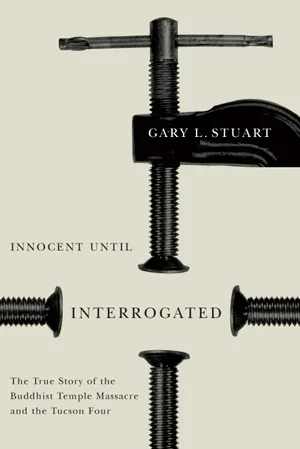
Innocent Until Interrogated
Gary Stuart Innocent Until Interrogated: The True Story of the Buddhist Temple Massacre and the Tucson Four University of Arizona Press330 pages, 6 x 9 inches ISBN 978 0816529247
Available here →September 20, 2010
20100920-gary-stuart-innocent-interrogated-buddhist-temple-tuscon-massacre-3
A close-up
The rest of this thread
Gary Stuart
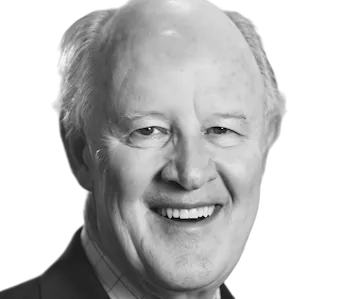
Gary Stuart earned degrees in business and law at the University of Arizona, served as an editor of the Arizona Law Review, and for thirty years practiced law at Jennings, Strouss, & Salmon, one of Arizona’s largest law firms. Early in his career, he began to teach, write, and lecture at both the local and national levels. He tried more than a hundred jury cases to a conclusion and earned the rank of Advocate as a juried member of the American Board of Trial Advocates. Stuart completed an eight-year term on the Arizona Board of Regents and served as its president from 2004 to 2005. His published work includes scores of law-review and journal articles, op-ed pieces, essays, stories, more than fifty Continuing Legal Education booklets, and six books, including Miranda: The Story of America’s Right to Remain Silent (University of Arizona Press, 2004). He is Senior Policy Advisor and Adjunct Professor of Law at Arizona State University’s Sandra Day O’Connor College of Law, where he teaches appellate advocacy, ethics, and legal writing.
Pull this thread
Innocent people confess to crimes as grave as mass murder because interrogators induce them to.
Know something the rest of us don't?
Most threads on Rorotoko begin with our invitation. Any thread can begin with a proposal: you write it with the same prompts every thread answers, and we review it.
Propose a thread →