
Gary Stuart
Innocent Until Interrogated
My book is a stark but comprehensive look at what really happened following the discovery of two seemingly unrelated cases of murder near Phoenix, Arizona, in 1991. The first case involved nine victims. Six Buddhist monks, a nun, and two temple workers were executed at a monastery west of Phoenix on the night of August 9–10, 1991.
In the second case, someone shot Alice Marie Cameron twice in the back with a nine-millimeter handgun, for the change in her purse, at a remote public campground north of Phoenix the following October 17.
Officers from the Maricopa County Sheriff’s Office (MCSO) investigated what they erroneously thought were unrelated cases.
Intense political and media pressure to solve a mass murder, coupled with a lack of experience on the part of the commanders at the MCSO, created a political and personal nightmare in both cases.
Overlooking vital clues in the first case, the MCSO rounded up four men who were identified by a mental patient in the Tucson Psychiatric Institute and coerced four patently false confessions from them.
That ignoble effort led to the extraction of another coerced false confession from a hapless mental patient in the second case. He had been out of the hospital for only a few days and just happened to be staying at the campground where the second murder took place—but he was looking for attention.
The cases really began to unravel when the sheriff’s office belatedly checked the ownership of a gun from a presumably unrelated case. They’d had the gun in their possession for six weeks without submitting it to the state crime lab for ballistics analysis. It turned out to be the murder weapon.
This led directly to the arrest of three teenage boys from Avondale. All three lived near the Buddhist Temple, and one of them had close connections to the temple. Two of the boys confessed. Fourteen months later, the prosecutor discovered that one of the two was also the killer in the campground case.
The title of my book, Innocent Until Interrogated, is a nod to what happened to the innocent men rounded up in Tucson and transported in handcuffs to the MCSO’s interrogation chamber in Phoenix. The book parses and crosschecks what really happened, who cared about it, and why the wheels of justice collapsed.
But there is more to this story than just false confessions.
In July 1994 a seventeen-year-old boy stood trial in the Buddhist Temple case. The jury decided he was only a follower and acquitted him of premeditated murder while finding him guilty of felony murder. The judge rejected the death penalty, instead sentencing him to nine consecutive life sentences.
In February 2010 the U.S. Circuit Court of Appeals for the Ninth Circuit decided that the now-thirty-six-year-old convict had also given a coerced confession, and the court ordered the state to take reasonable measures to retry him without his coerced confession. The book is about false and true police-induced confessions.
Editor: Erind Pajo
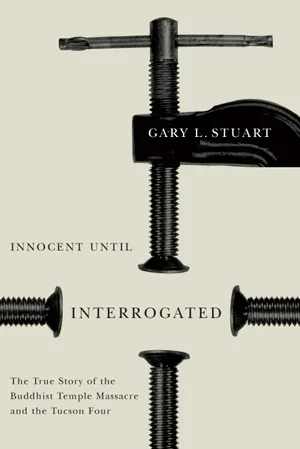
Innocent Until Interrogated
Gary Stuart Innocent Until Interrogated: The True Story of the Buddhist Temple Massacre and the Tucson Four University of Arizona Press 330 pages, 6 x 9 inches ISBN 978 0816529247
Available here →September 20, 2010
20100920-gary-stuart-innocent-interrogated-buddhist-temple-tuscon-massacre-1
In a nutshell
The rest of this thread

Gary Stuart
Gary Stuart earned degrees in business and law at the University of Arizona, served as an editor of the Arizona Law Review, and for thirty years practiced law at Jennings, Strouss, & Salmon, one of Arizona’s largest law firms. Early in his career, he began to teach, write, and lecture at both the local and national levels. He tried more than a hundred jury cases to a conclusion and earned the rank of Advocate as a juried member of the American Board of Trial Advocates. Stuart completed an eight-year term on the Arizona Board of Regents and served as its president from 2004 to 2005. His published work includes scores of law-review and journal articles, op-ed pieces, essays, stories, more than fifty Continuing Legal Education booklets, and six books, including Miranda: The Story of America’s Right to Remain Silent (University of Arizona Press, 2004). He is Senior Policy Advisor and Adjunct Professor of Law at Arizona State University’s Sandra Day O’Connor College of Law, where he teaches appellate advocacy, ethics, and legal writing.
Pull this thread
Innocent people confess to crimes as grave as mass murder because interrogators lead them to.
Know something the rest of us don't?
Most threads on Rorotoko begin with our invitation. Any thread can begin with a proposal: you write it with the same prompts every thread answers, and we review it.
Propose a thread →