
Alan Taylor
The Civil War of 1812
Between 1792 and 1812, about 30,000 Americans left the republic to seek land in Upper Canada. They became known as the “Late Loyalists,” but most were just looking for the cheap land that the British granted to new settlers who would take an oath of allegiance. By 1812, these Americans and their children were most of the inhabitants in Upper Canada (now Ontario).
That fact led American leaders to target Upper Canada for invasion—in the hope that the settlers would welcome and assist the invaders. But the British expected those settlers to defend the colony against any American invasion. When war came, these newcomers faced a tough choice: would they fight for their farms and against their kin and former neighbors in the invading armies?At the same time, thousands of British emigrants poured into American seaports.
Primarily from restive Ireland, the newcomers fled from British rule to seek economic opportunity and political liberty in the republic. Becoming staunch Republicans, the Irish-Americans sought a revenge on the empire. They served in disproportionate numbers in the armies that invaded Upper Canada. Defeats cast scores of Irish-Americans into British prisons, where they had to enlist in the royal forces or face trial as traitors. The British took that hard line because they feared for the loyalty of their own soldiers in Canada—who were mostly from Ireland.
By punishing the Irish captured bearing arms for the United States, the British set an example meant to preserve discipline in their own heavily Irish army along the border. To save the imprisoned Irish-American soldiers, the American government threatened to execute a captured Briton for every American immigrant hanged by the British. In an escalating spiral, most of the prisoners on both sides became hostages for the fate of the Irish-American soldiers threatened with British trial.
So this civil war pitted the Irish against the Irish, Americans against other Americans, and native peoples against their own kin.The War of 1812 began as a second round of the revolution but it ended as a transition into a new era where the United States and the British had to coexist, however uneasily, along a more sharply defined boundary. Despite later boundary controversies and even cross-border raids by private adventurers, the two nations avoided another war. Paradoxically, by producing a military stalemate, the War of 1812 reassured both sides that they could survive the presence of the other in a shared continent. Canada and the United States took shape from the bitter experiences of a civil war in a shared borderland.
Editor: Erind Pajo
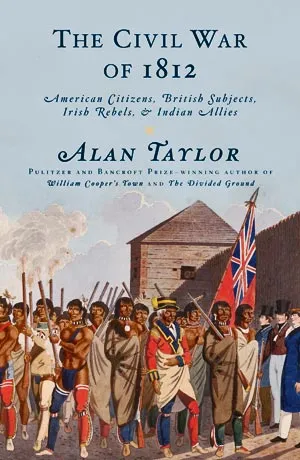
The Civil War of 1812
Alan Taylor The Civil War of 1812: American Citizens, British Subjects, Irish Rebels, & Indian Allies Alfred A. Knopf656 pages, 6 1/4 x 9 1/4 inches ISBN 978 1400042654
Available here →November 15, 2010
20101115-taylor-alan-on-war-1812-american-citizen-british-subject-irish-reb-3
A close-up
The rest of this thread

Lynn Friedman
Alan Taylor
Alan Taylor is a professor at the University of California at Davis. The Civil War of 1812, featured in his Rorotoko interview, is his sixth book. His William Cooper’s Town won the 1996 Pulitzer Prize for American history—in addition to the Bancroft and Beveridge prizes. Of his other books, American Colonies won the 2001 Gold Medal for Non-Fiction from the Commonwealth Club of California, and The Divided Ground won the 2007 Society for Historians of the Early Republic book prize as well as the 2004-7 Society of the Cincinnati triennial book prize. Recipient of numerous teaching awards, Alan Taylor is active in the History Project at UC Davis, which provides curriculum support for K-12 teachers in history and social studies. He is also a contributing editor for The New Republic.
Pull this thread
The War of 1812 was a civil war among kindred peoples, and its stalemate made Canada and the United States.
Know something the rest of us don't?
Most threads on Rorotoko begin with our invitation. Any thread can begin with a proposal: you write it with the same prompts every thread answers, and we review it.
Propose a thread →