
Larry Bennett
The Third City
The Third City is an unconventional interpretation and explanation of contemporary Chicago.
By exploring this iconic American city, I comment on broader trends in American urbanism. And what I mean by American urbanism is the cluster of attributes that define cities in the United States. These attributes include decentralized and relatively low-density metropolitan regions, a high degree of socio-economic segmentation within metropolitan regions, continued (but not always successful) efforts to create busy downtown areas and congenial residential districts, ongoing economic challenges as cities seek to attract private investment, and again—across metropolitan areas—great disparities in the provision of public services and access to other public amenities.
Chicago is one of the United States’ most observed cities—by visitors and social scientists, as well as by local journalists, scholars, and creative writers. Rich literatures have contributed to a particular view of Chicago that resonates locally and across the United States—dynamic but culturally parochial, the site of a perpetual civil war pitting reformers against “the machine,” “the city of neighborhoods.”
In The Third City I seek to determine how relevant these images continue to be, and to the extent they should be set aside or at least modified, what are the most striking features defining the emergent Chicago. Further: how is this new Chicago—what I characterize as the third Chicago—influencing the broader shape of American urbanism?
This is a book for readers who appreciate cities. It’s especially for those observers of cities who are struck by the paradoxical character of American urbanism: revitalized downtown and near-downtown residential areas, persistent social disparities, seemingly unending suburbanization—even in the face of energy and broader environmental constraints.
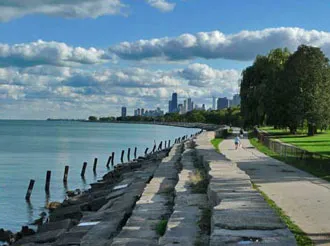
At many points along Chicago’s lakefront the fusion of city and nature is breathtaking. Photo by Larry Bennett
Editor: Erind Pajo
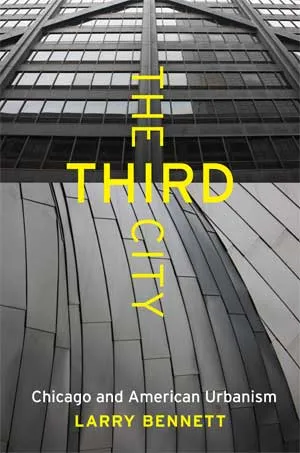
The Third City
Larry Bennett The Third City: Chicago and American Urbanism University of Chicago Press 248 pages, 8 1/2 x 6 inches ISBN 978 0226042930
Available here →December 1, 2010
20101201-bennett-larry-on-third-city-chicago-american-urbanism-1-1
In a nutshell
The rest of this thread
Larry Bennett
Larry Bennett teaches in the Political Science Department of DePaul University. His most recent books are two co-edited volumes, The New Chicago: A Social and Cultural Analysis (Temple University Press, 2006) and Where Are Poor People to Live?: Transforming Public Housing Communities (M.E. Sharpe, 2006). Professor Bennett is co-editor of the book series Urban Life, Landscapes, and Policy, published by Temple University Press. For many years he has served as a board member of one of Chicago’s leading neighborhood economic development non-profit organizations, The LEED Council.
Pull this thread
Chicago is now an arts-rich global city, and its inherited images obstruct seeing what it actually is.
Know something the rest of us don't?
Most threads on Rorotoko begin with our invitation. Any thread can begin with a proposal: you write it with the same prompts every thread answers, and we review it.
Propose a thread →