
Larry Bennett
The Third City
The Third City’s second chapter walks the reader through a series of Chicago literatures: sociological analyses, city planning documents aiming to describe future Chicagos, contemporary fiction set in Chicago, the journalism of Mike Royko. The purpose is to illustrate some persistent “themes” in the interpretation of Chicago, pinpoint how these themes sometimes cross from, say, journalism to fiction, and ultimately, explain how the power of these themes can get in the way of coming to terms with the realities of the contemporary city.
Your “just browsing” reader might want to begin with Mike Royko, who is typically described as the quintessential Chicago observer. A lifelong resident of the city, Royko’s columns “speak” in an unvarnished Chicago dialect and present a city of straight talkers, many of them ethically challenged or racially narrow-minded. His work, at its best, combines irreverent humor and astute social observation.
Royko’s work is also willfully imaginative, as demonstrated by his tour de force “day in the life of Daley” that constitutes the opening chapter of Boss, his profile of Mayor Richard J. Daley. In these thirty or so pages, Royko moves from an account of Daley’s hour by hour movements—a narrative that is enlivened by well-chosen quotations illustrating the mayor’s view of the world—to a far more speculative inner monologue that has been invented by Royko to expose what “the Boss” was really thinking.
Though many readers construe Royko as just providing the facts and nothing more, Mike Royko’s Chicago is part reportage, and part skillful projection. Moreover, his columns during the last 10 to 15 years of his career increasingly turned to nostalgic reminiscence, reminiscence that at times seemed to lose track of the contemporaneous Chicago the older Royko thought he was observing.
I have been lucky enough to pursue a profession that has allowed me to explore in great depth a personal passion, cities. I have also been lucky enough to travel widely and visit cities in many parts of the world. I am the kind of urbanite who could be happy living in many places. As it so happens, I have spent most of my adult life in Chicago. That experience, living in this city, has been a great pleasure but also the source of much intellectual stimulation.
I would like to think that The Third City will open up new insights on Chicago and provoke both residents and others to reconsider their possibly “received” sense of this city. Then there is the larger question that drives my exploration of Chicago’s particularities. What lessons from contemporary Chicago might be useful in thinking about how to form better cities both in the United States and elsewhere?
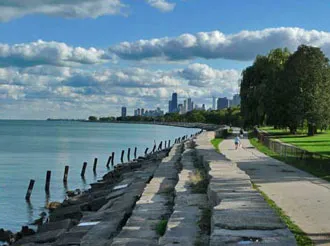
At many points along Chicago’s lakefront the fusion of city and nature is breathtaking. Photo by Larry Bennett
Editor: Erind Pajo
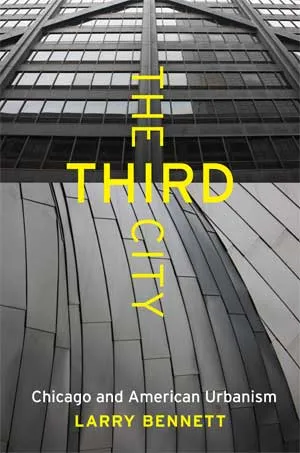
The Third City
Larry Bennett The Third City: Chicago and American Urbanism University of Chicago Press 248 pages, 8 1/2 x 6 inches ISBN 978 0226042930
Available here →December 1, 2010
20101201-bennett-larry-on-third-city-chicago-american-urbanism-3
A close-up
The rest of this thread
Larry Bennett
Larry Bennett teaches in the Political Science Department of DePaul University. His most recent books are two co-edited volumes, The New Chicago: A Social and Cultural Analysis (Temple University Press, 2006) and Where Are Poor People to Live?: Transforming Public Housing Communities (M.E. Sharpe, 2006). Professor Bennett is co-editor of the book series Urban Life, Landscapes, and Policy, published by Temple University Press. For many years he has served as a board member of one of Chicago’s leading neighborhood economic development non-profit organizations, The LEED Council.
Pull this thread
Chicago is now an arts-rich global city, and its inherited images obstruct seeing what it actually is.
Know something the rest of us don't?
Most threads on Rorotoko begin with our invitation. Any thread can begin with a proposal: you write it with the same prompts every thread answers, and we review it.
Propose a thread →