
Ayanna Thompson
Weyward Macbeth
While Macbeth may not fit neatly into the category of a “race” play, like a specter it is nevertheless haunted by, and haunts, the language and performances of race.
Othello, in contrast, plays something of an over-determined role in historical and contemporary constructions of racial difference; one reviewer of Paul Robeson’s performance in 1944 even went so far as to call it “Shakespeare’s American play.”
Macbeth subtly lures you into thinking that the “Scottish play” doesn’t carry “the onerous burden of race,” as the actor Harry Lennix puts it. This lure is so powerful that actors, directors, and writers often assume that they are the first to see the connections.
To the contrary, Macbeth has long played a role in American constructions of race. Orson Welles’s 1936 Federal Theatre Project (FTP) production of Macbeth—commonly referred to as the “Voodoo” Macbeth—is often discussed as the innovation of Welles’s singular and immense creative genius.
But there was an all-black FTP production the year before in Boston—as well as a number of amateur productions in previous decades.
Likewise, starting in the 1970s and continuing to this day, many contemporary theatre companies repeatedly assume that they are the first to re-stage Welles’s “Voodoo” version. But several African-American, Asian-American, Native American (Alaskan and Hawai’ian), and Latino theatre companies have turned to Macbeth to help stage their own unique racial, ethnic, and cultural identities.
Macbeth’s appeal—that it lacks “the onerous burden of race”—comes at a price. Despite the fact that many of the non-traditionally cast productions bill themselves as unique translations—the first to change Scotland to the Caribbean, “Africa,” an urban ghetto, a multi-racial post-apocalyptic future, and so on—they can only do so by employing a type of historical amnesia.
That is the play’s true magic, and perhaps its curse as well. Could anything be more Shakespearean and American?
Editor: Erind Pajo
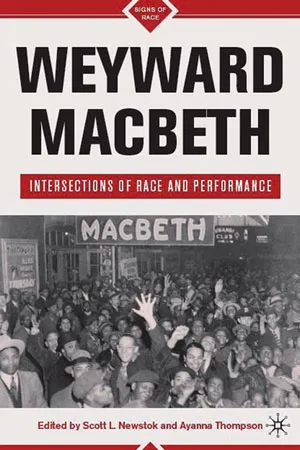
Weyward Macbeth
Scott Newstok and Ayanna Thompson, Editors Weyward Macbeth: Intersections of Race and Performance Palgrave Macmillan 308 pages, 6 1/8 x 9 1/4 inches ISBN 978 0230616424
Available here →December 27, 2010
20101227-scott-newstok-ayanna-thompson-on-weyward-macbeth-race-performance-2
The wide angle
The rest of this thread

Ayanna Thompson
Ayanna Thompson is Associate Professor of English, and an affiliate faculty in Women & Gender Studies and Film & Media Studies at Arizona State University. She is author of Performing Race and Torture on the Early Modern Stage (2008), and the editor of Colorblind Shakespeare: New Perspectives on Race and Performance (2006). Her new book on Shakespeare and race, called Passing Strange, is forthcoming from Oxford.
Pull this thread
Macbeth, not only Othello, sits at the center of American racial construction.
Know something the rest of us don't?
Most threads on Rorotoko begin with our invitation. Any thread can begin with a proposal: you write it with the same prompts every thread answers, and we review it.
Propose a thread →